Highlights From the 2026 ACEC Fall Conference

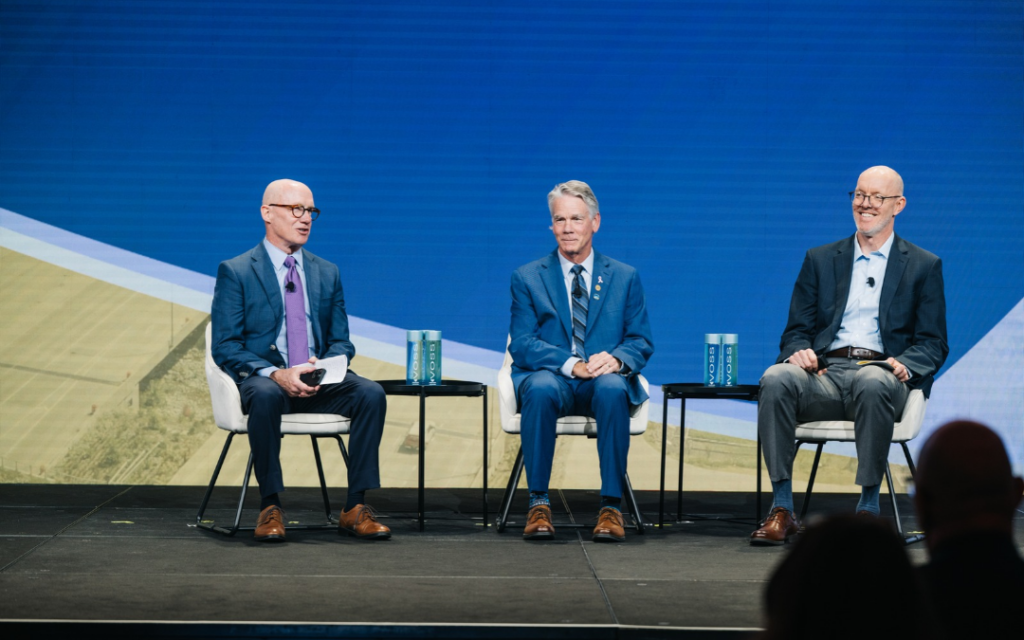
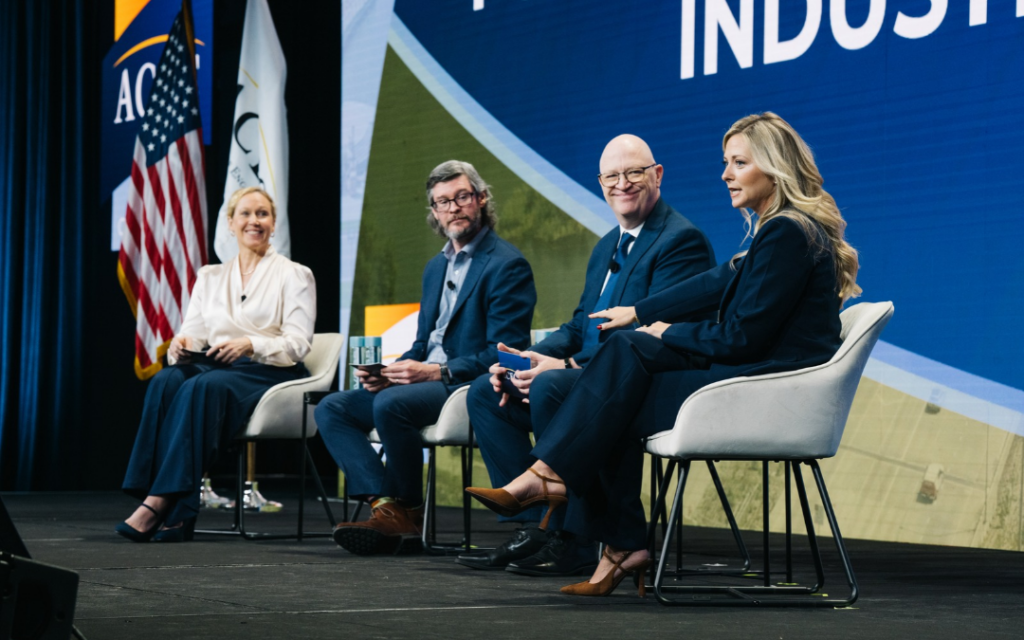
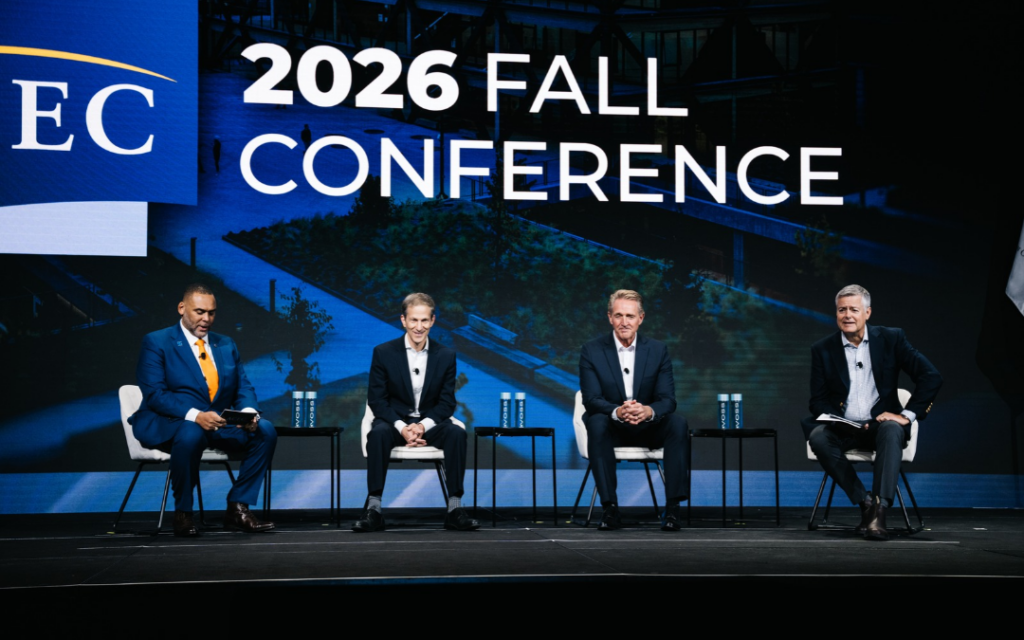
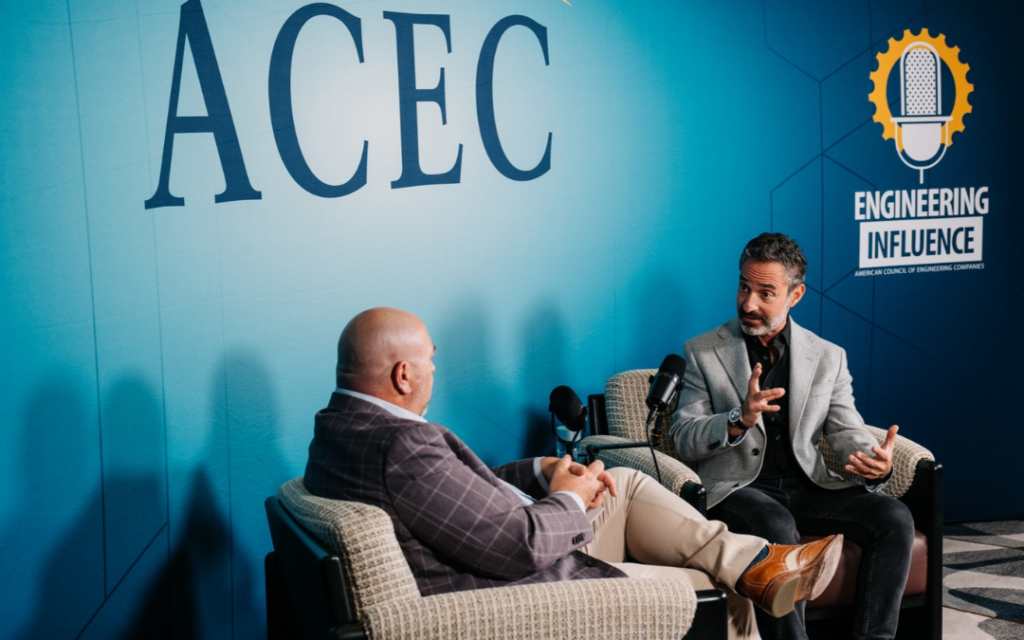
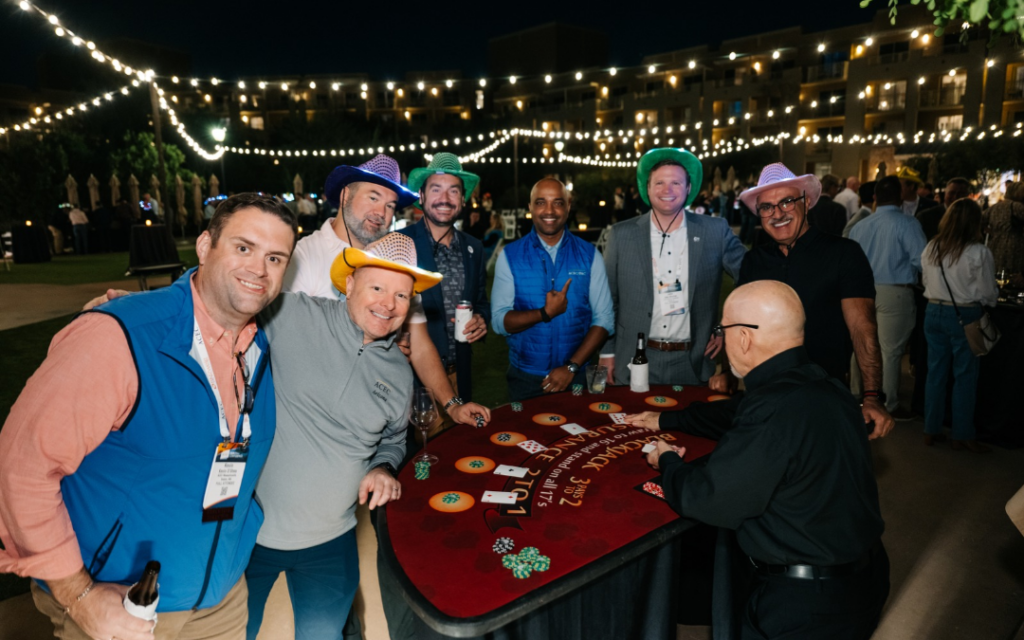
More than 1,000 members attended ACEC’s 2026 Fall Conference in Phoenix, Arizona. The four-day event was packed with business education sessions, networking opportunities, and featured forward-looking keynote presentations. See more Fall Conference highlights below:
Linda Bauer Darr Delivers Remarks to ACEC Board of Directors
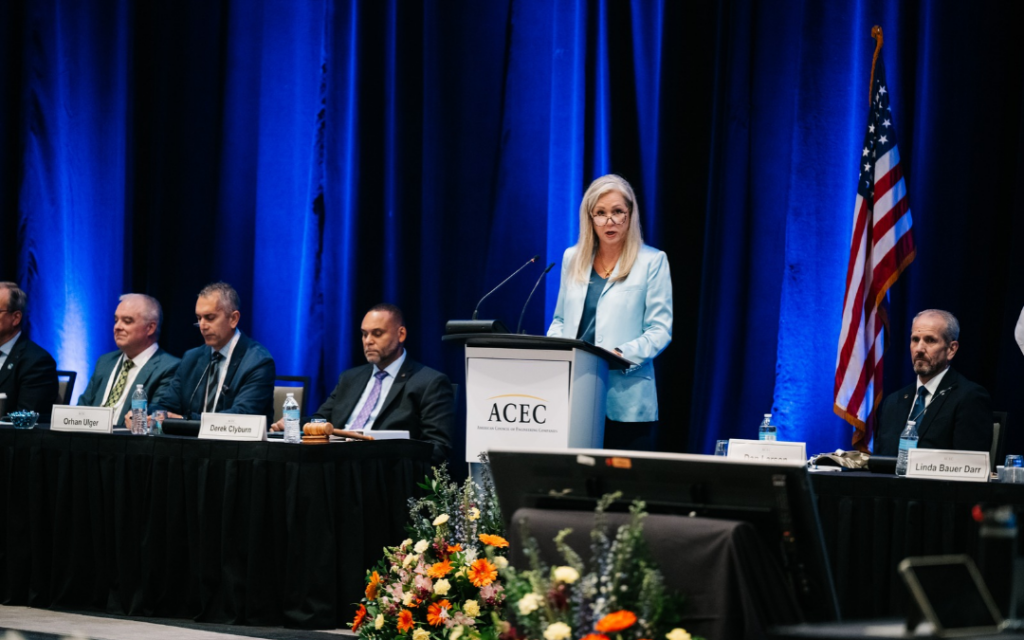
Addressing ACEC’s Board of Directors at the Sunday opener of the 2026 Fall Conference in Phoenix, President & CEO Linda Bauer Darr gave an honest and blunt assessment of the turbulence member firms are facing, alongside a deeply optimistic and confident view of the industry’s and ACEC’s ability to prevail amid that turbulence. Her message was clear: the old rules no longer apply, and the firms that thrive in this brave new world will be the ones that stop reacting and start deciding.
“Our members are finding themselves at a point where conventional wisdom is no longer serving them,” said Darr. “Because not much is conventional these days. And on some days, it feels like wisdom has left the room completely.”
Her assessment of the landscape was stark. When the Board last met in May, she noted, the consensus held that the Federal Reserve would sit tight. Instead, the Fed voted unanimously last month to raise rates for the first time since 2023. “When Kevin Warsh took the job, the markets expected a dove. Instead, they got a Chair who had no choice but to be aggressive on inflation.”
Then there are tariffs, which have proven impossible to kill, despite years of litigation. Meanwhile, construction costs keep rising, led by electrical systems straining to support the data center boom. In September, diesel hit a record $6.53 a gallon. “Every engine turning over on a jobsite across this country is now burning some of the most expensive fuel in American history,” Darr said.
She pointed to the ACEC Research Institute’s most recent sentiment survey as indicative of the prevailing mood: 72 percent of firm leaders are “significantly concerned” about inflation, and their outlook for the U.S. economy has slipped deeper into negative territory.
And yet.
Those same executives, in that same survey also report remarkable confidence in their own balance sheets, with a median backlog of a full year of work. The constraint isn’t demand. As ever, it’s people. “We can’t keep up with the volume of work, and we still can’t find enough people to do the job,” said Darr.
Invoking John F. Kennedy’s 1962 line about repairing the roof while the sun shines, Darr joked that sunshine has been scarce of late, but that doesn’t preclude preparedness. “When the storms refuse to let up,” she said, “the roof is only as strong as what holds it up.”
Darr outlined the four pillars of the strategic plan refinement greenlit by the Board in May, describing it as a deliberate choice, rather than a reaction.
“Organizations that react get pushed by events. Organizations that decide get to shape them.”
Of the first – digital transformation – Darr noted that AI presents the industry with tools that can imitate judgment. “That’s not a reason for panic, but it is a reason for seriousness,” she said. Pointing to the Research Institute’s recent Leading Through AI Risk report, she declared that the study treats artificial intelligence as neither a “miracle nor a menace,” instead treating it as what it is: “a powerful instrument that demands governance.”
Discussing the second pillar, workforce, Darr spotlighted the Pipeline Project, launched this summer with ACE Mentor to pair students with practicing engineers. “AI will change how engineers work, but it won’t change the fact that we need more of them,” she declared.
The third pillar is licensure, for which Darr made an emphatic case alongside a push for preserving and expanding Qualifications-Based Selection (QBS), declaring the issues two sides of the same coin.
“Licensure answers who should do the work. QBS answers how they should be chosen. And both give the same answer to why. It’s because competence is not a luxury when lives are on the line. The shortcut always looks cheaper…right up until it isn’t,” she said.
Last, but certainly not least: membership. Darr reported 71 new member firms in the first quarter of FY27. Every victory won on Capitol Hill or in statehouses comes down to numbers. Growing our membership is the engine behind every policy ACEC pushes to deliver. Every new voice is another reason for a lawmaker to take a meeting.
That’s going to be particularly important in the coming months, with more than 100 new lawmakers headed to Washington come January. Darr declined to prognosticate margins or majorities in next week’s midterms, instead insisting that both the Council and the industry are uniquely positioned and prepared to bring order to chaos even in a gridlocked Washington.
“Our work is essential,” she said, “so our work endures.”
ACEC Chair Dan Larson Addresses Tuesday General Session
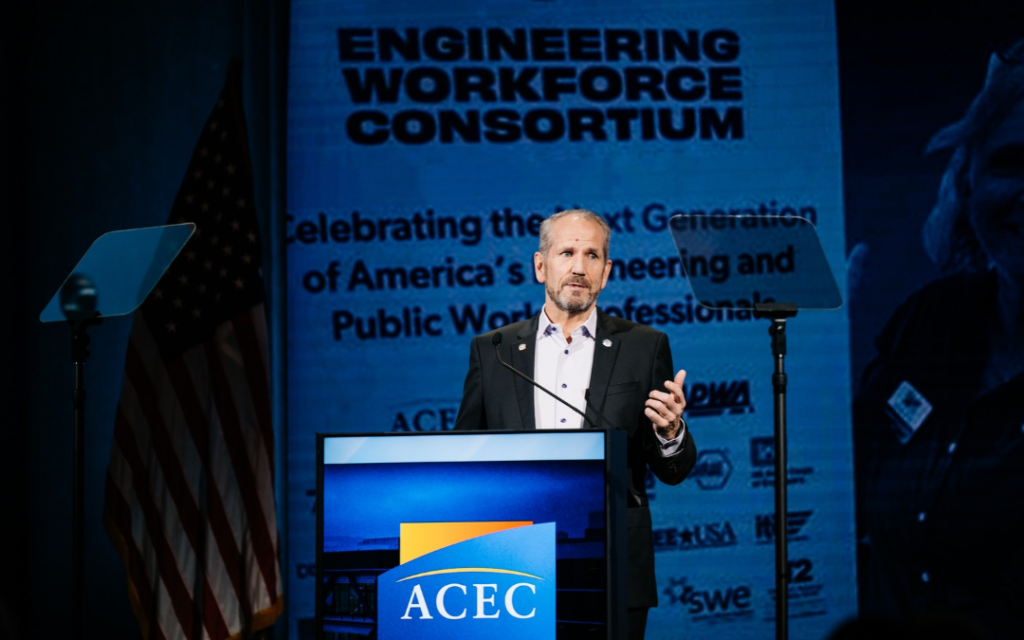
With exactly one week to go before voters head to the polls, ACEC Chair Dan Larson made two predictions Tuesday morning: Washington is bracing for divided government, and ACEC is poised to serve as a bridge.
Larson told General Session attendees that the conventional wisdom predicts the House flipping to Democrats, with the Senate remaining a true tossup. “Whatever happens,” he said, “the watchword of the 120th Congress is likely going to be gridlock.”
Infrastructure’s Bipartisan Advantage
But Larson rejected another tenet of conventional wisdom that divided government inevitably means getting nothing done. “It could be a recipe for paralysis, but I prefer to think of it as an opportunity for leverage.” He rested that assertion on the simple premise that infrastructure is the rare issue that transcends partisan rancor and warfare.
“Ideology is fleeting, but infrastructure is not,” he said. “Bridges don’t care who chairs what committee. The grid doesn’t stay on because one side dominated the news cycle.”
A Narrow Window for Action
The strategic implication is urgent, Larson asserted. With surface transportation likely slipping to the incoming Congress, the window for influence is open, but not indefinitely. “Openings close,” he said. “If we want Congress to reach across the aisle, we have to be the ones standing in the middle, with credible data and practical solutions creating the connection…. Our obligation is to bring facts when others bring talking points, and to think in decades when Washington thinks in election cycles.”
Growing Leaders
That mission depends on people, with leadership development not as an add-on, but as the core of ACEC’s work. “Developing leaders can’t be a side project,” Larson declared. “It is the project.”
He went on to give a brief discussion of the four focus areas the ACEC Board approved in May to sharpen the strategic plan: digital transformation; licensure; membership; and workforce. Of membership, Larson offered a memorable line: “Strength in numbers isn’t just a cliché. It’s currency.”
A Reason to Lead
But through it all, advocacy remains the anchor, what Larson referred to as “our foremost commitment.” And with a bitterly divided, gridlocked Washington that is likely to become even more bitterly divided and gridlocked, Larson closed his remarks with a call to action to attendees.
“History suggests that many will treat [divided government] as a reason to stall. We will treat it as a reason to LEAD.”
Darr Opens General Session with Remarks on Leading Through Uncertainty
Engineers are trained to think in straight lines. Every action has an equal and opposite reaction. Every road has a path. But on Monday, ACEC President & CEO Linda Bauer Darr told a room full of engineers that in the business of engineering, the straight line has started to bend, and the firms that thrive will be the ones willing to bend with it.
Darr set the scene with a nod to local history. Monday marked the 145th anniversary of the Gunfight at the OK Corral, which unfolded in Tombstone, about three hours from the Conference’s Phoenix setting. “The fight itself lasted only about 30 seconds, but we’ve spent 145 years talking about it,” she said.
Hollywood, she noted, turned that story into a tidy tale of white hats and black coats. Real life is murkier. She pointed to the moment in the movie Tombstone when Morgan Earp, dying, admits to his brother Wyatt that the heavenly light he’d once described simply isn’t there. “It ain’t true,” Morgan says. “I can’t see a damned thing.”
Darr said the scene captures the mood heading into next week’s midterms, with more than 450 House and Senate seats at stake and little clarity from either side about what comes next. For an industry built on order and risk mitigation, that’s an uncomfortable state of affairs.
A Rough Year for the Typical Firm
Darr asked attendees to picture a typical ACEC member firm: 40 employees, mostly transportation work, the kind of firm that handles road projects, small bridge repairs, and traffic studies. That fictional firm has had a rough year. The Department of Transportation ended the DBE program’s presumption of disadvantage, in place since 1983. The SBA proposed raising the engineering size threshold from $25 million to $252 million, pitting the firm against companies ten times its size. Then came the tariff wars, which brought delays, smaller scopes and, in some cases, outright cancellations.
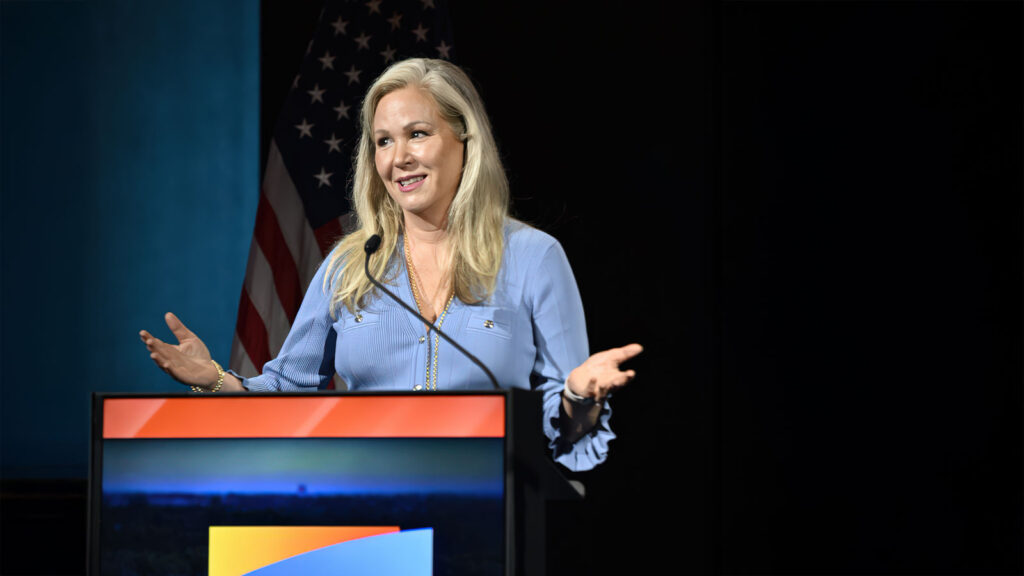
Workforce pressures add to the strain. Darr described a senior engineer who won’t learn AI and younger engineers who won’t touch it on principle. Add private equity circling the firm and eyeing it “like a shark looks at a shrimp cocktail,” and it’s no wonder firms feel squeezed. “If it feels like the world is on fire,” she said, “you aren’t imagining the heat.”
The AI Equation
So, what about AI? The easy math says it boosts productivity, so hours and costs fall while profits rise. “It’s all tidy and logical,” Darr said. “But is it?”
Clients may demand lower fees for fewer hours, unless firms start pricing on the value of their judgment. “We have spent a century proving the value of engineering,” Darr said. “Now we must learn to capture more of the value we create.” She also questioned how young engineers will build professional judgment if AI absorbs their routine work and urged firms to secure the rights to their own data. “We can’t just supply the ingredients while someone else owns the restaurant.”
Why the Stamp Still Matters
Darr insisted engineering’s core value isn’t going anywhere. “A stamp is a promise that a human being with training, experience, and a conscience has looked at this work and will stand behind it,” she said. “In times like these, our judgment matters more. Not less.”
The industry’s future, she said, depends on strong engineering fundamentals and real fluency in technology. Getting there, she argued, requires a “bigger table,” a role ACEC has played for more than 120 years.
Eyes on the Horizon
Darr closed by returning to a joke she heard when she joined ACEC nearly a decade ago: the introverted engineer looks at his own shoes, while the extroverted engineer looks at yours.
In uncertain times, she said, the instinct is to look down and watch every step. “The instinct is understandable, but it’s never built anything worth building.”
Her final charge to attendees: “Look out to the horizon, see the road that isn’t there yet, and build it.”
Team Rubicon’s Jake Wood: From Combat to Communities
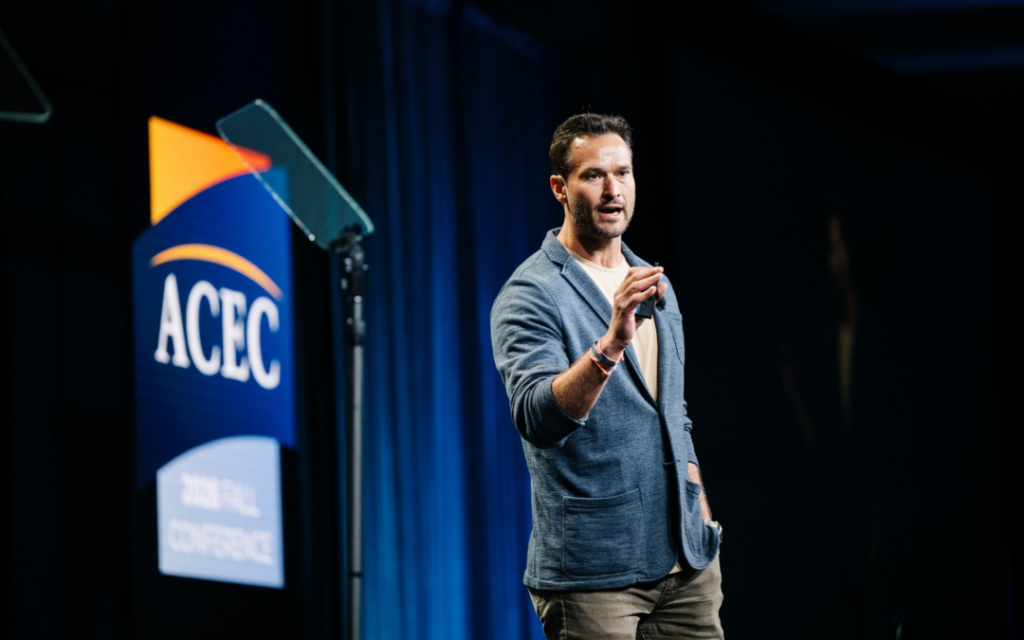
It’s not every day that a keynote speech opens on an ancient battlefield. But that’s exactly how Team Rubicon founder Jake Wood began his remarks at Monday’s Opening General Session. Wood reached back more than 2,000 years to the pre-Socratic Greek philosopher Heraclitus and his famous breakdown of 100 men heading into combat, from the 80 who are merely targets (in corporatespeak, they’re the clock punchers), the 10 who shouldn’t be there at all, the nine who are the real fighters, and the one true warrior.
That “one,” Wood said, is the person who holds the scared responsibility of bringing all the others home. The question he asked is: How do we become that person in our own work? The stakes of an engineering firm may differ from those of an ancient battlefield, but the premise holds: how do you build a team of warriors who show up even (especially!) in moments when it’s easier not to?
Childhood Inspiration
Wood lived in Europe for part of his childhood. A visit to the site of the Mauthausen concentration camp in Austria as a 10-year-old opened his eyes to “the depths of what human beings were capable of.” Wood shared that before this tour, his concept of evil was limited to Wile E. Coyote. But in experiencing the horrors of the Holocaust, something else clicked for Wood that day. In one of the buildings at Mauthausen were a number of black and white photos of troops liberating the camp. “These were 18, 19-year-old kids, not much older than I was,” Wood said. “It was inspiring. That was what I aspired to be.”
From Football to the Marines
Fast forward a few years. Wood has left Europe and returned stateside, settling in Iowa, and eventually playing football at University of Wisconsin. The 18-year-old made the 18-year-old’s choice, opting for dreams of an NFL career versus a career in the military. Wood first questioned that choice one sunny morning in September 2001, when he strolled into his school dining hall for breakfast — just in time to see the second plane hit the World Trade Center.
“I made the wrong choice,” Wood said. “The world hadn’t changed yet.”
It was during his senior year when football star Pat Tillman was killed in Afghanistan that Wood had what he called his “man in the mirror moment.” He joined the Marines and was deployed to Iraq in 2007 during The Surge. Two weeks into his deployment, the lead Humvee in his caravan encountered an IED. The driver stumbled from the destroyed vehicle, suffering from a horrific wound. His first words to Wood were to ask for a radio to coordinate the evacuation.
Leadership Is About Love
That was when Wood made the realization that leadership is about love. It’s about giving the people who work with you a sense of safety. The formula, Wood said, is that love equals safety and safety equals courage.
Safety was in short supply in Wood’s next role — a sniper hunting the Taliban. When his tour ended, he wasn’t sure what he wanted to do next. “I figured I’d get an MBA, like everyone else who doesn’t know what they’re doing with their life,” he joked.
Team Rubicon Is Born
Then another disaster once again changed the course of Wood’s path. The 2010 Haiti earthquake killed 150,000 instantly; another 100,000 would die in the ensuing days and weeks. Wood looked at the coverage and was struck by how familiar it looked.
It looked like the warzone he’d just left.
Determined to leverage his “unique set of skills,” Wood volunteered his services to assist with the recovery effort. His offer was rebuffed, but Wood was undeterred. He headed to Port-au-Prince, determined to build “the best disaster response in the world.” From that effort, Team Rubicon was born.
Wood’s thinking was simple. Two million men and women were returning from the Mideast, taking off their uniforms, and no one was asking them to do anything with their skills. Team Rubicon has grown to nearly 200,000 volunteers who have placed boots on the ground in disaster after disaster: earthquakes, fires, civil unrest, hurricanes, and tsunamis.
“If it’s a bad thing that’s happened, Team Rubicon has been there,” Wood said.
Building A Story Worth Fighting For
So, what’s the leadership lesson in disaster response? How do you unlock the heroes of your own firm?
Wood has an answer.
“Every organization is a story. Your mission statement should be like a Bat Signal that makes someone want to work for you. Is the story you tell worth fighting for?”
All That Jazz: Josh Linkner on Improvising to Innovate
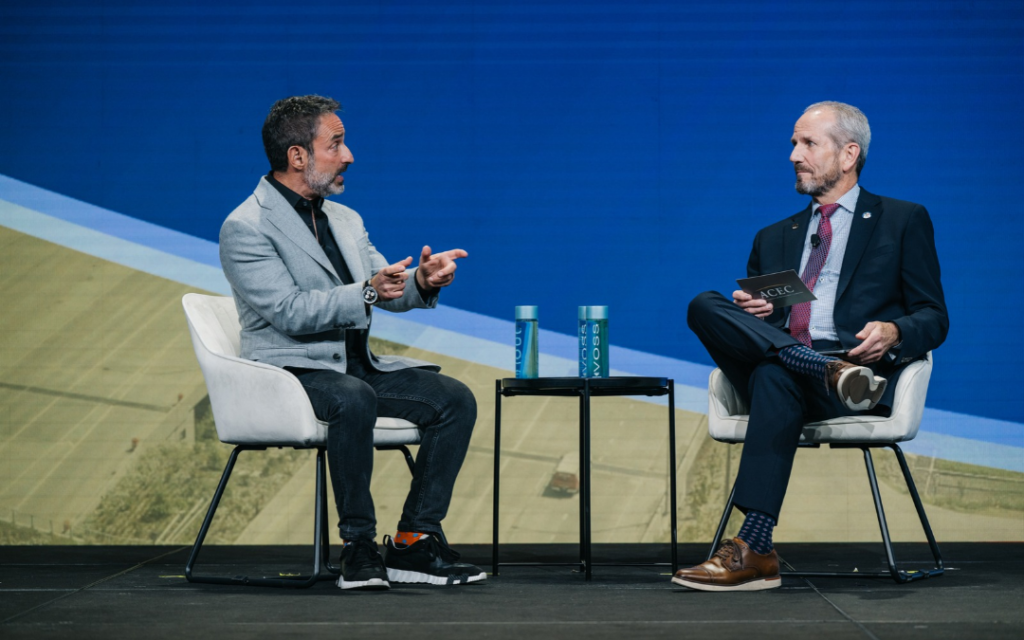
It was an unusual assertion to make in front of a room full of people who solve complex problems for a living, but entrepreneur, jazz musician, and author Josh Linkner made it just the same: the way you’ve been innovating up to now is probably no longer enough.
Don’t Limit Yourself to Notes on a Page
Linkner opened his remarks Monday afternoon with a true story that illustrates the kind of thinking that separates the creative from the stuck. Linkner’s firm was seeking a massive contract with Conagra, the company behind iconic brands like Orville Redenbacher and Duncan Hines. Linkner was a finalist, but the goalposts kept moving and it was beginning to look like it was not going to be a go.
Linkner found himself on the same flight as the person in charge of signing the contract; both were upgraded to adjacent first-class seats, while the Conagra contact’s wife was consigned to economy. Linkner thought fast. The easy answer was to take the shot — sit next to “Mr. Conagra,” take the 30,000-foot captive audience, and use the flight as the ultimate elevator pitch. That’s not what happened. Instead, Linkner offered his first-class seat to “Mrs. Conagra,” saying he planned to spend the flight working anyway, and that the spouses should sit together. When Linkner checked his phone upon landing, a message from his office was waiting for him.
The contract was a done deal. The jazz musician had just improvised his way into a $30 million payday.
Tapping Your Inner Coltrane
All of us are built to be creative, Linkner said. And tapping that creativity is especially important in moments of major cultural change. It’s moments like these that call for tapping into your inner jazz musician.
“One percent of jazz is notes on the page,” he said. “The rest is improvised.”
And in that improvisation are lessons for leaders.
Consider.
Linkner showed a list of five traits of jazz musicians. They adapt to changing conditions. Navigate uncertainty and ambiguity. Have situational awareness and employ active listening. Use real-time collaboration and problem solving. Recover quickly from setbacks. Improvise to deliver the best outcomes.
Look at that list. Now swap out “jazz musicians” for “leaders.” Nothing changes.
Postage Stamp Moments
The best innovators know that everything isn’t, can’t be, shouldn’t be a moonshot. But even small things can have big, big results.
Case in point. In 1902, French engineer Philippe Bunau-Varilla was lobbying for a new interoceanic canal to be built in Panama rather than Nicaragua, so he sent a Nicaraguan postage stamp to every member of Congress depicting a volcano in Nicaragua. His message was simple: if Nicaragua featured an active volcano on its postage stamps, perhaps it was not the safest place for an interoceanic canal.
The rest is history. Panama got the canal – and the $1 trillion in economic impact that goes along with it.
“You don’t have to be DaVinci,” Linkner said. “Just look for postage stamp moments.”
Going Bananas
If there is one lesson Linkner would impart it would be this: Start before you’re ready. “There’s real risk in waiting. It’s best to figure it out as you go.”
Jesse Cole was flat broke when he saw a notice that Savannah, Georgia’s minor league baseball team was headed for bankruptcy court. On a whim, he attended the disposition hearing and expressed interest. He was the only one there, so the judge gave him a shot at turning it around. Cole did more than turn it around. He turned the newly branded Savannah Bananas into the most successful team in baseball, powered by an obsessive focus on innovation and customer experience. Today, the Bananas are a worldwide phenomenon, boasting more than 36 million social media followers (eclipsing MLB teams) and selling out Fenway Park.
As a Savannah Bananas board member, Linkner has had a seat behind home plate for the team’s meteoric rise. The lesson in Cole’s story is no surprise to any jazz musician accustomed to playing everything by ear. There’s no such thing as a “right” way to play jazz.
Just as there’s no “right” way to innovate. The only wrong thing is to do nothing.
“I know I’m not going to get it right,” Linkner said. “The confidence comes from knowing that I know how to recover.”
Artist Phil Hansen: Redraw Your Own Boundaries
Artist Phil Hansen built his early work on painstaking pointillism. He was in art school when he developed a tremor in his drawing hand. It looked like the end of his career; his style depended on precision and patience, and his hand would no longer cooperate. Came the blunt verdict from a neurologist: permanent nerve damage, the kind that made the fine, detailed work that defined his early career impossible.
It is the kind of news that immediately forces you to reevaluate your life. “I found myself staring at a wall,” Hansen told Tuesday’s afternoon General Session attendees. It seemed that art was no longer an option until that same blunt neurologist offered an equally blunt piece of advice.
“Embrace the shake.”
When the Tool Breaks, Get New Tools
With those words came an eventual realization: Hansen’s art career wasn’t over. The road hadn’t ended. The horizon simply changed.
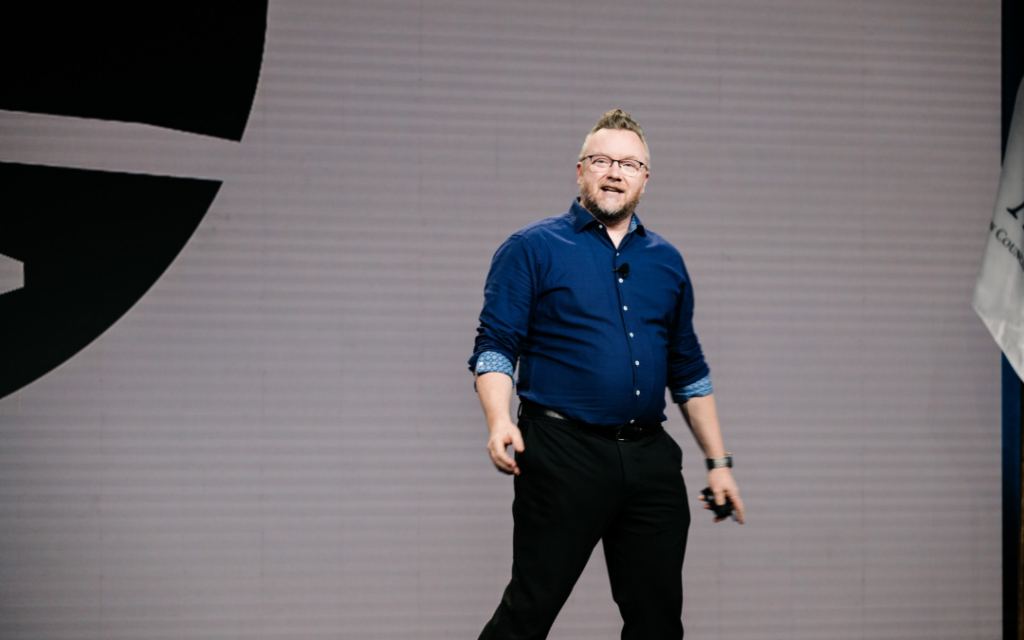
Shortly after that fateful doctor’s appointment, Hansen was up late watching the Bruce Lee classic Enter the Dragon. With his hands no longer suited for pointillism, Hansen was struck by another idea. He created a portrait of Bruce Lee using the sides of his hands, literally karate chopping paint onto a canvas until it formed Lee’s face.
That sparked another idea, a series of pieces Hansen called “Goodbye Art.” The concept? Create art intended to be destroyed immediately after completion – including a portrait of Jimi Hendrix made of matchsticks, which disappeared in a plume of smoke when lit, or one made entirely of frozen red and white wine that melted into oblivion. All told, Hansen created – and destroyed – 23 pieces of art.
“Destruction seems brave,” he said. “It’s about learning to let go. It was the most creative I’ve ever been.”
Engineers Get Creative; Hilarity Ensues
The stage set, Hansen then told Fall Conference attendees that it was their turn to make art of their own by completing a series of tasks using an app. The first task was easy: write your name using a supplied stylus. The next was a bit trickier: draw your pet. (Nervous giggles.) Then a curveball: write down your biggest worry (all anonymous) and sketch a design around it. Now, color the box completely black and draw something you can’t live without.
“Finally,” Hansen said, “I would like you to look across your table, find someone you don’t know – and draw them.”
The earlier nervous giggles become full-on uncomfortable laughter.
The collaboration part over, Hansen then showed some of the drawings. They ranged from quite impressive to cartoonishly awful, but this wasn’t an exercise designed to surface an undiscovered virtuoso. When the attendees’ collective artwork was finally pulled together, it became a composite of the Hoover Dam. There’s a lesson here. The whole is always worth more than its parts, and what we build together outlasts anything we could carry alone.
Hansen closed his presentation by sharing one last piece of his art, the idea for which came to him as he was driving home with a greasy bag of fast-food burgers. When he saw that the grease had changed the color of the bag, he decided to try to create art using nothing but hamburgers. He showed a video of the work in progress: dozens of hamburgers, which Hansen strategically pressed against the canvas until a familiar face emerged. When he was done, he had produced a replica of the Mona Lisa, appropriately titled the Mona Grease-a.
Reproducing masterpieces where the medium is medium-rare is about as far as possible from where Phil Hansen’s art career began. The exacting work of pointillism is no longer in the cards. But Hansen’s story is a reminder that what feels like an ending is often just a beginning we haven’t discovered yet.
“The key to rethinking is learning the difference between limitation and self-limiting belief.”
Navigating the New Executive Order
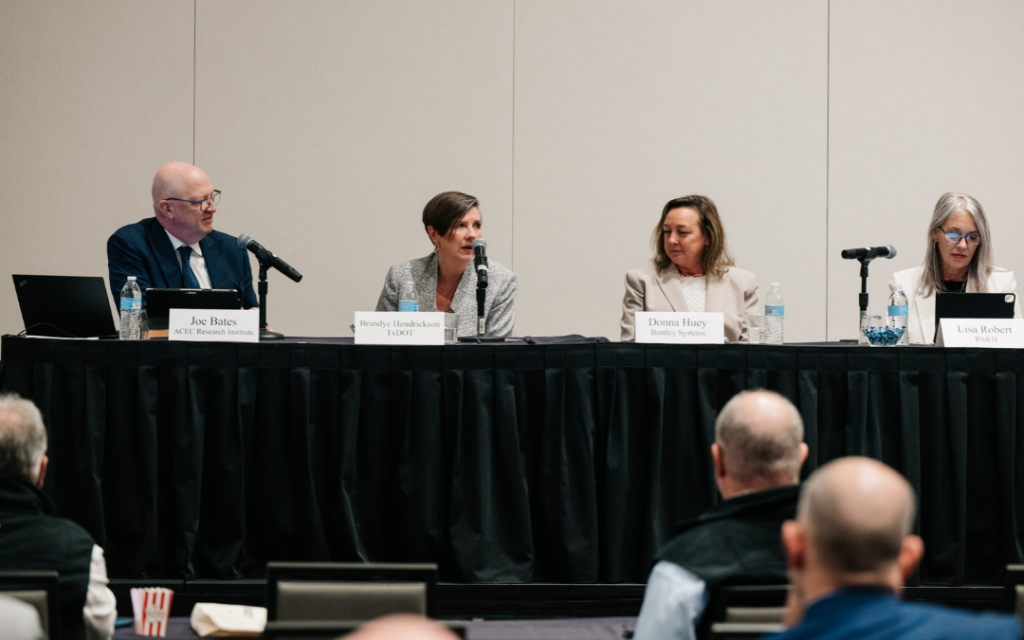
A panel moderated by Masai Lawson, senior talent acquisition manager at GFT, explored the implications of the executive order on DEI discrimination for federal contractors. Panelists included Janie Tiedeman, senior vice president of RS&H; Elizabeth Rudolph, general counsel of Pennoni; April Rai, president and CEO of COMTO; and Adrienne Johnson, deputy chief officer of North County Transit District – San Diego Railroad.
The executive order (EO) has created confusion about what federal contractors are and are not allowed to do with respect to inclusion and belonging while remaining in compliance. Penalties for noncompliance with the EO include possible termination of contracts and debarment.
Panelists agreed that firms should center their values and then determine how to remain in compliance with the EO. Firm leaders should be consistent in supporting and communicating the firm’s values even amidst changing circumstances in the world.
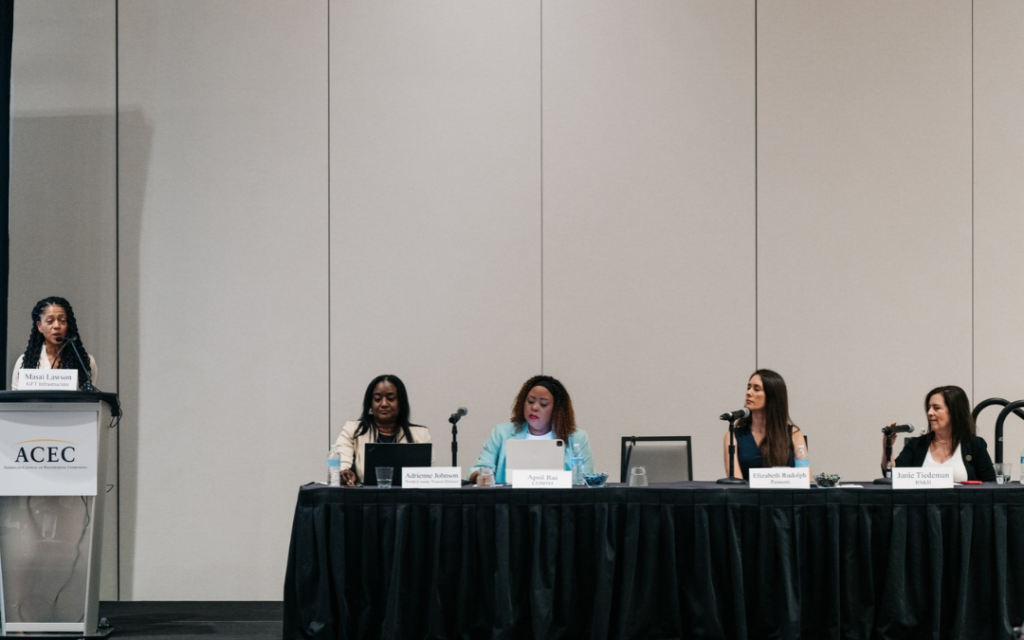
As an engineering firm legal counsel, Elizabeth Rudolph recommended carefully reading the executive order to understand what it says, as opposed to what the headlines suggest. It’s also important for firms to read their contracts – especially new ones – and be clear about what they require so that firms can avoid creating restrictions that don’t exist. Rudolph pointed out that there are free and low-cost legal resources that could help smaller firms navigate this space, such the firm’s insurance broker, their state legal department, and alerts from law firms such as Ogletree and Littler. They could also consider paying an attorney a one-time fee to review the firm’s programs.
The panelists urged attendees to prioritize their employees’ needs while maintaining compliance with government regulations. Masai Lawson noted that compliance sets the boundaries, but effective leadership determines how organizations operate within them.
Redesigning the Playing Field: Expanding Competition to Deliver Better Infrastructure
A panel of ACEC member firm representatives discussed how firms can actively support procurement approaches that build small business capacity and strengthen partnerships. Moderator Laura Merryfield of Partners for Public Good outlined the key features and recommendations of a new Procurement Playbook released by the Equity in Infrastructure Project, a CEO-level pledge to increase contracting opportunities for small and historically underutilized businesses. Representatives from AECOM, HNTB, and Luster shared their own professional experiences and explored how public agencies and firms can structure projects and teams to reduce unnecessary barriers, expand participation, and improve long-term value.
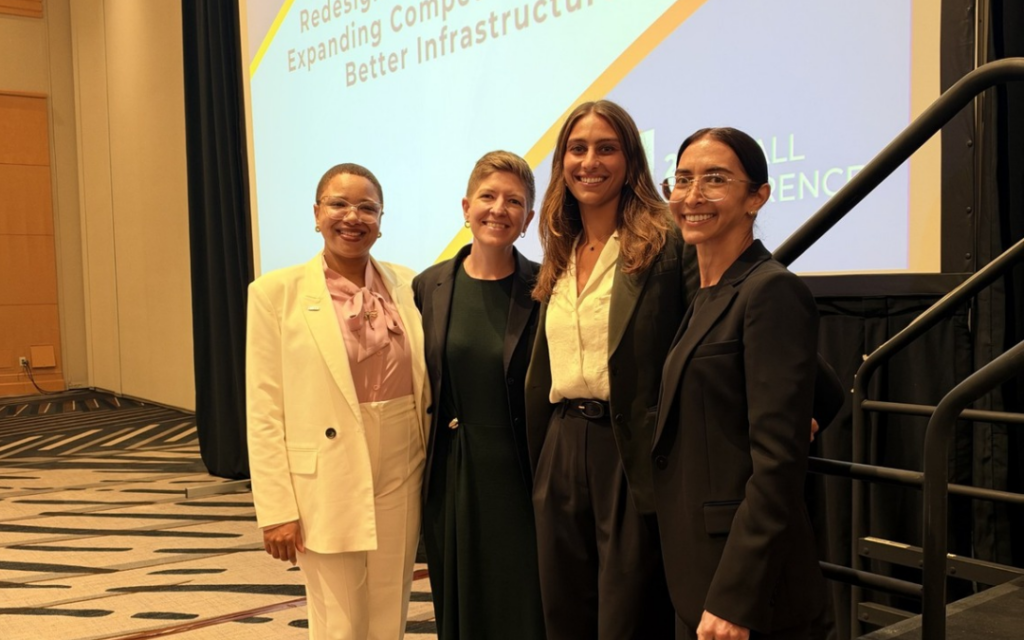
The panelists shed light on the recent changes, explaining both their background and their significance, made by the U.S. Department of Transportation to the federal Disadvantaged Business Enterprise (DBE) Program, including implications for certified DBEs and large firms that typically partner with them. Attendees gained practical insights into how the industry can foster entrepreneurship and mentoring to build a deeper, more resilient pool of firms capable of delivering quality infrastructure and concrete strategies to bring to their public-sector partners. Panelists shared their perspectives on how these approaches can increase innovation, strengthen performance, and create a healthier long-term market.
Market Intelligence Committee Explores the Future of Housing
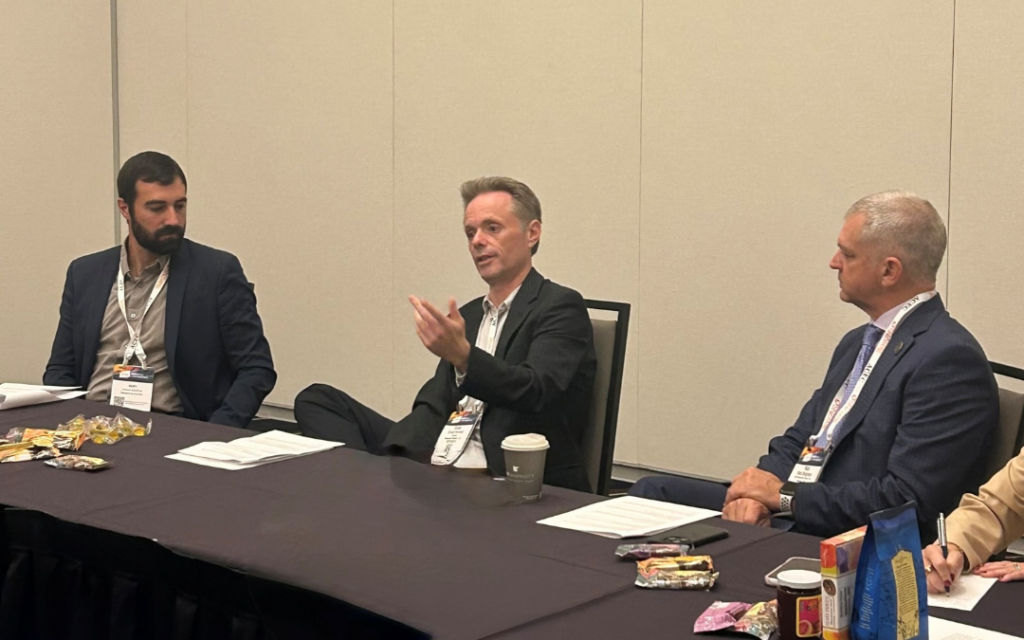
ACEC’s Market Intelligence Committee explored emerging trends in the housing market during a discussion with Evan Forrest, vice president of Zonda Advisory, and Cameron Tomasbi, PE, director of engineering at Cavco Industries. Forrest and Tomasbi offered insights into the increasingly localized nature of housing performance, the growing focus on attainability over affordability, and the influence of demographic shifts, consumer confidence, and regulatory barriers on housing demand and supply.
The conversation also explored the future of residential development, including changing buyer preferences, workforce shortages in construction, and the potential for modular housing to drive innovation and expand housing availability. While market conditions remain challenging, participants noted that long-term demand remains strong, underscoring the need for new approaches to housing delivery, workforce development, and regulatory reform.
Technology Track Sessions: How Firms are Putting AI to Work
Artificial intelligence was the common thread across the Technology Track sessions at the Fall Conference, and the strongest message was that firms need to move from interest to practical action. Holly Buck of Felsburg Holt & Ullevig shared how FHU used the final year of its five-year strategic plan to focus on innovation and AI, where an employee-led initiative informed the firm’s pilot of an AI-based organizational platform, from the decision to act through deployment. In a presentation on agents, Brock Storrusten, Chandra Storrusten, and Dennis Boone argued for a leadership-led operating model. They recommended using usage analytics to identify internal champions and following a “start small, scale fast” roadmap that prevents siloed efforts. Attendees also built a simple agent of their own on their phones.
Several sessions focused on keeping quality and accountability at the center of AI adoption. GPD Group and Structured AI presented a case study on bringing AI into QA/QC across a multidisciplinary firm. GPD treats Quality Assurance and Quality Control as two distinct risk mitigation tasks. The AI tool operates within Assurance, the processes in place before a milestone, and does not replace the formal review that makes up Control. Rather than deploying firm-wide, the team mapped workflows discipline by discipline. They then rolled the tool out in phases, starting with champion users who went on to lead training for their colleagues. Katherine Golden of MA Mortenson Company addressed the question “If AI designs it, who signs it?” She covered the legal and ethical obligations that stay with engineers, including confirming the reliability of AI output, demonstrating competence, and maintaining responsible charge.
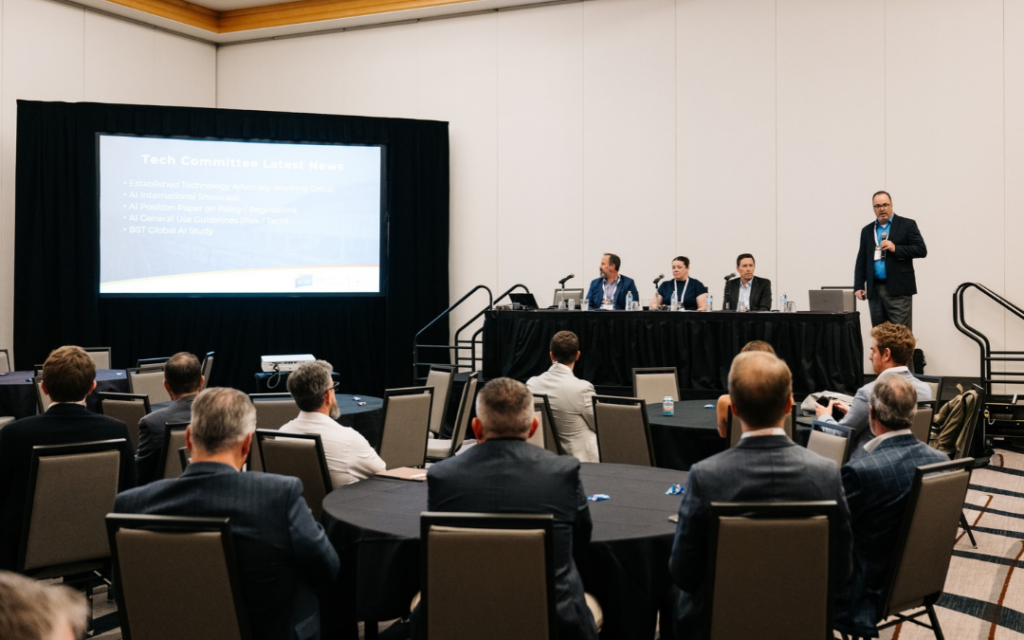
Other speakers addressed the business and human sides of the shift. Jim Rogers of Impellor Group noted that being busy does not always mean being profitable. He encouraged firms to look at revenue concentration, succession exposure, and margin leakage, and to build broader relationship capability instead of simply pursuing more work. Tahra Porterfield and Staci Brinson of AXA XL tackled AI fatigue, noting that faster production can also raise the cost of coordination, review, and decision-making, and that the “human in the room” often bears that cost. Their message was that firms need to find a balance between information overload and neglecting a transformative technology.
Finally, at the in-person Technology Committee meeting, a panel of high-scoring firms in three of the size categories of the 2nd Annual ACEC Technology Benchmarking Survey shared their perspectives and insights on the use and adoption of AI in engineering firms. From building new technology-based service lines to overcoming challenges, the panelists provided a lively discussion that broadly illustrated the state of AI and technology in the engineering industry.
ACEC/PAC FALL CONFERENCE SWEEPSTAKES WINNERS
The $10,000 sweepstakes winner is Ben Henderson, Kimley-Horn and Associates, Arizona. The winner of $7,500 is Kyle Koivuiemi, Kimley-Horn and Associates, California. The following individuals each won $5,000: Jason Matson, Kimley-Horn and Associates, California; Adam Clayton, JT Engineering, Inc., Wisconsin; and Greg Purvis, Wetherill Engineering, North Carolina.
The following individuals were winners of $2,500: David Scott, ACEC Iowa; Matt Barlow, Kimley-Horn and Associates, California; and Travis Todd, Thomas and Hutton, Tennessee.
Ten members were winners of $1,000: Brent Pitcher, GRAEF, Wisconsin; Michael Holder, GFT, North Carolina; Mark Harris, Kimley-Horn and Associates, Texas; Leyla Hedayat, Kimley-Horn and Associates, California; Paul Elman, Kimley-Horn and Associates, Virginia; Josh Mickle, Mickle Griffin, LLC, Arkansas; Carlos Penin, C.A.P Engineering, Florida; Kris McCullough, GARVER, Oklahoma; Heath Turbiville, HDR, Wyoming; and Brent Mutti, Kimley-Horn and Associates, Arizona.
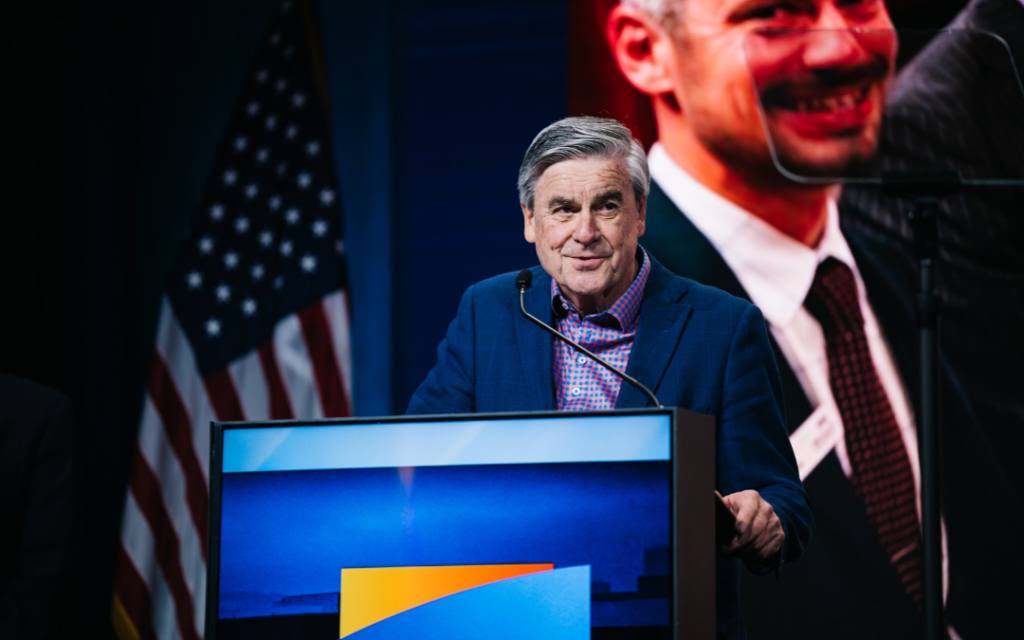
ACEC CONGRATULATES OUR 2026 AWARD RECIPIENTS
2026 ACEC DISTINGUISHED SERVICE AWARD
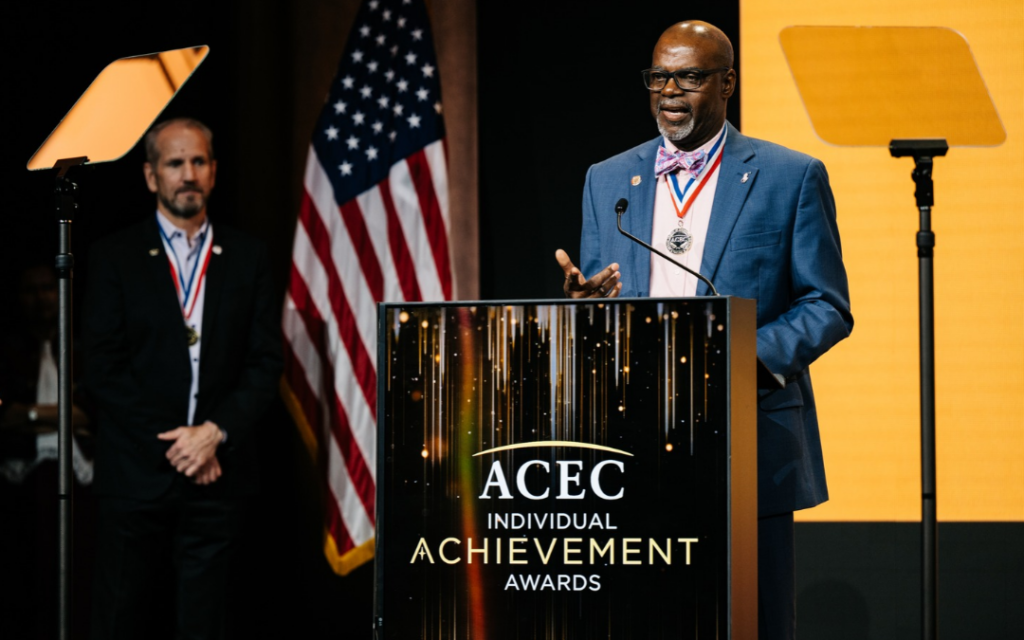
The 2026 ACEC Distinguished Service Award was presented to Melvin Williams, who was honored for his dedication and contributions to ACEC and the engineering profession. Conferred by the ACEC Committee of Past Chairs, the Distinguished Service Award recognizes individuals who have provided outstanding service and support to the Council.
2026 COLLEGE OF FELLOWS INDUCTEES
● Tanya Adams, SVP, Director of Diversity and Strategic Partnerships, WSP – ACEC Illinois
● Rob Brigham, CEO, JEO Consulting Group, Inc. – ACEC Nebraska
● A. Gray Clark, PE, President, Muller Engineering Company, Inc. – ACEC Colorado
● Jeffrey A. Cowen, PG, PE, President, Building & Earth Sciences – ACEC Alabama
● Louis J. Gallucci, PE, Executive Vice President, V3 Co – ACEC Illinois
● Brad B. Hammond, PE, Vice President/Local Area Leader, Olsson, Inc. – ACEC Arkansas
● Kurt Heidenreich, PE, SE, CPESC, Founder & President, Engineering Resources, Inc. – ACEC Indiana
● Brian Hynniman, PE, Principal-In-Charge, HMB Professional Engineers, LLC – ACEC Alabama
● Arthur A. Jones-Dove, PE, CCM, MBA, PMP, PGMP, Vice President and Mid-Atlantic Water Sector Manager, TYLin – ACEC Metropolitan Washington
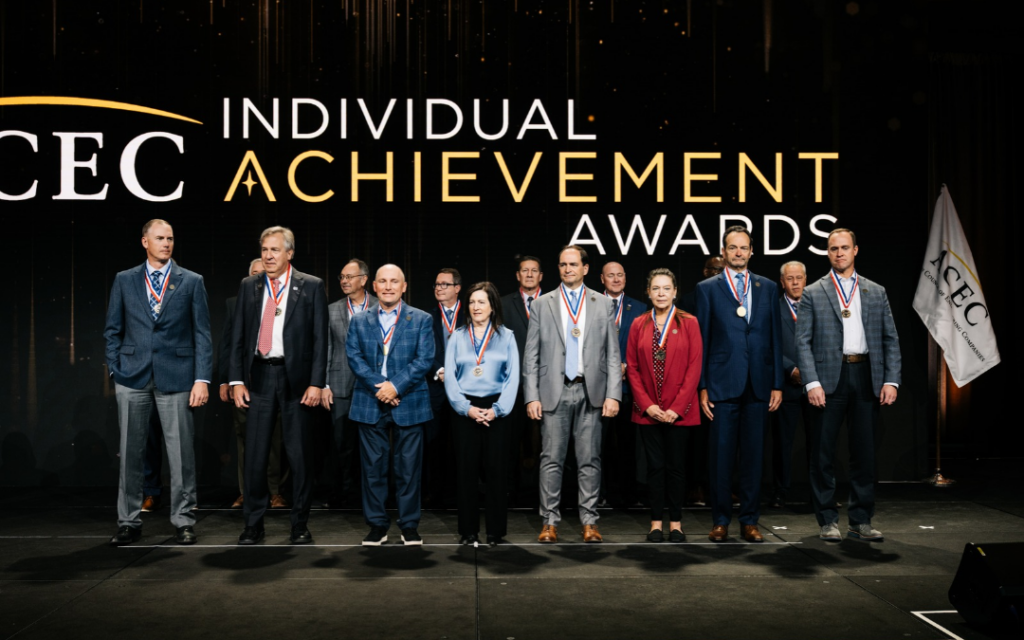
● Andre’ “Andy” Lauzier, PE, Senior Vice President, HDR – ACEC Florida
● Heath Overfield, PE, CEO, Engineering Associates – ACEC Wyoming
● Jerald T. Payonk, PE, Chairman of the Board, Clark Dietz, Inc. – ACEC Illinois
● Jeffery A. Sockel, PE, VMA, Senior Vice President, Alfred Benesch & Company – ACEC Nebraska
● Jane L. Tiedeman, PE, Senior Vice President, RS&H, Inc. – ACEC Maryland
● Paul Wasser, PE, GBU Department Manager, Schnabel Engineering – ACEC Idaho
● Janet L. Webster, PE, Managing Principal, Clark Nexsen, Inc. – ACEC Virginia
● Brian Welker, PE, Senior Vice President & COO, Crawford, Murphy & Tilly, Inc. – ACEC Illinois
● Steve Wurster, PE, President, Ruekert & Mielke, Inc. – ACEC Wisconsin
2026 COMMUNITY SERVICE AWARD
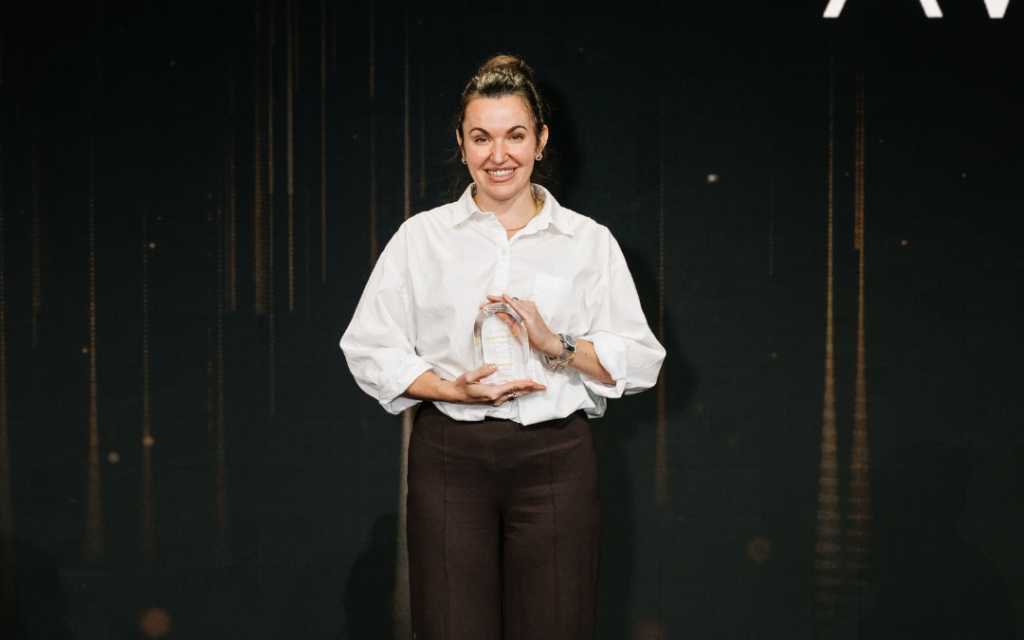
Monica Mosure, MBA, chief administrative officer at ms consultants and a leader in the ACEC Ohio community, received the 2026 ACEC Community Service Award. Recipients are recognized for civic and charitable leadership that has significantly improved the quality of life in their communities. Mosure’s service includes co-founding Private School Pups, which provides behavioral training and second chances to dogs in need, and mentoring a Little Sister through Big Brothers Big Sisters since 2017.
2026 COALITIONS DISTINGUISHED SERVICE AWARD
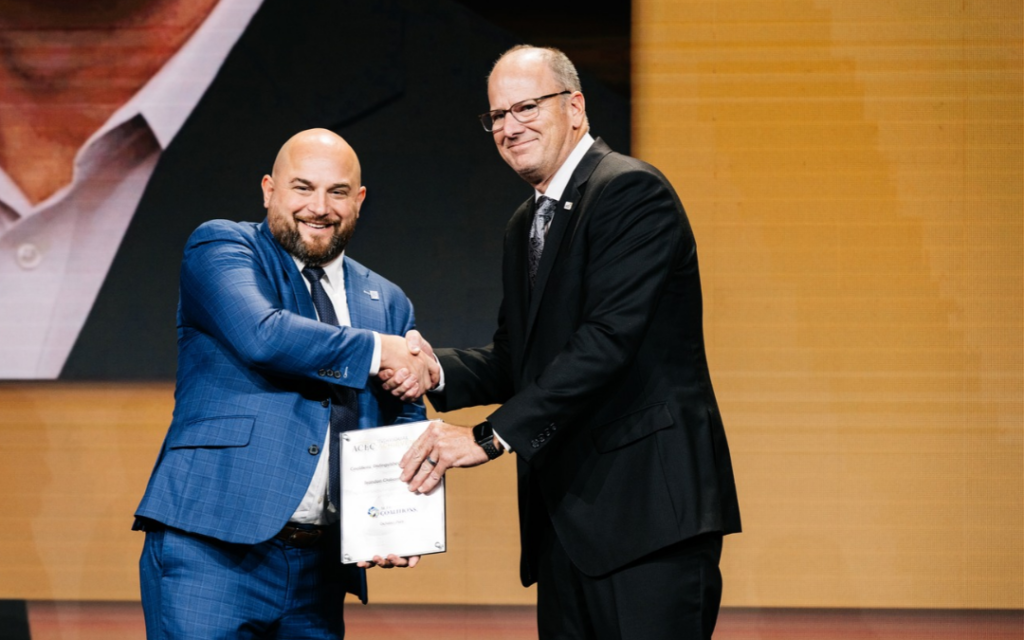
Brandon Claborn, vice president of environmental, WSB, received the 2026 Coalitions Distinguished Service Award, presented annually on behalf of ACEC’s Coalitions to recognize an individual whose dedication, service and volunteer leadership have made a significant contribution to the strength and success of the Coalitions. The award recognizes Claborn’s distinguished commitment to advancing the work of ACEC’s Coalitions and the broader engineering profession. Claborn serves as National Director for ACEC Oklahoma and has served as Chair
of the ACEC Coalition Leaders and Chair of ACEC’s Small Firms Coalition.
ACEC 2026 YOUNG PROFESSIONAL WINNERS
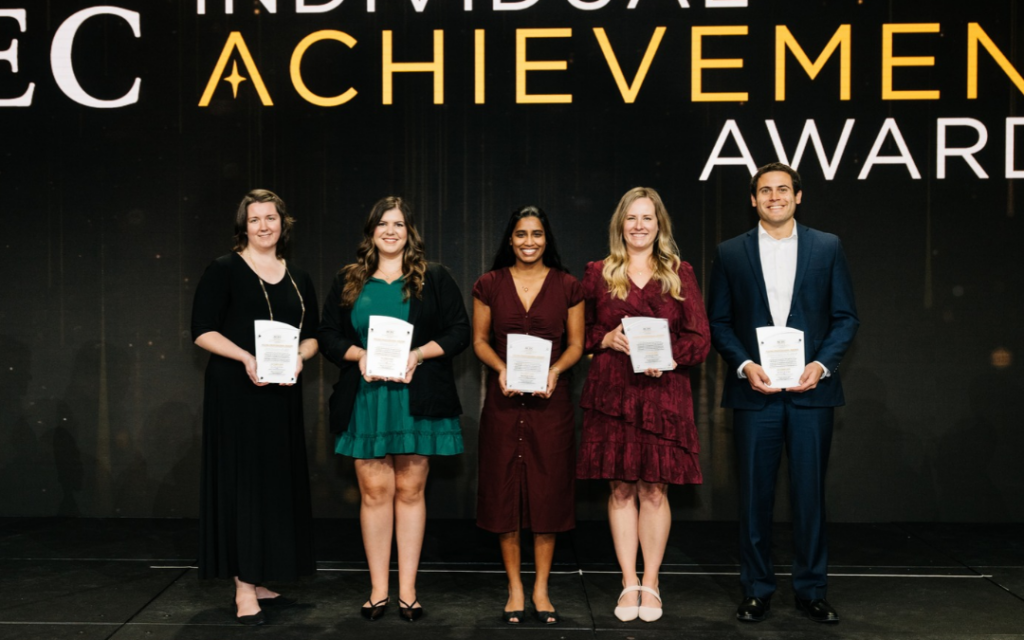
- Timothy D’Agostino, PE, Project Manager with P.W. Grosser Consulting (ACEC New York) – Named 2026 Young Professional of Year
- Kimberly Koehl, PE, Louisiana Group Manager, McKim & Creed (ACEC Louisiana)
- Farrell Nicholson, PE, Roadway Department Manager, Wetherill Engineering Inc. (ACEC North Carolina)
- Alyssa Sooklal, PE, ENV SP, CFM, Senior Project Engineer, Barton & Loguidice (ACEC Maryland)
- Raeanna Thiele, PE, Vice President and Geotechnical Engineering Department Manager, Thiele Geotech (ACEC Nebraska)
2026 NATIONAL QUALIFICATIONS-BASED SELECTION (QBS) AWARD WINNERS
- County of Ventura, California – Public Sector Award
- Mark Steiner, former senior policy director and senior consultant, ACEC – Individual Award
2026 ACEC RESEARCH INSTITUTE SCHOLARSHIP WINNERS
Click here to see the complete list of 2026 scholarship recipients who embody academic excellence and represent our profession’s future engineering leaders.
Click here to read about all ACEC 2026 Individual Achievement Award Winners.
See Other Conference Highlights Below: