
Wage Compression in the AEC Industry: Bridging the Pay Gap Between New Hires & Tenured Employees

It is no secret that the engineering and construction industries face a serious workforce shortage. With a tight labor market and limited talent pool, entry-level hires have been well-positioned to demand higher salaries over the past few years. Companies, especially in deadline-driven environments, often have no choice but to pay the premium to fill vacant roles.
These persistent conditions are causing wage compression—a narrow pay gap between new hires and long-term employees—and it has quickly become a pressing issue for companies in the AEC industry. The ripple effects of wage compression can be significant. Firms experiencing wage compression will face higher turnover, lower morale, and considerable financial risks. These consequences can be especially damaging in the highly collaborative, project-driven AEC environment.
While historically a rare problem, wage compression is now a systemic concern impacting firms of all sizes as the industry grapples with the complexities of a dynamic workforce and unpredictable economy. Now is a critical time for firm leaders and HR teams to reassess their compensation strategies to ensure resilience in the years to come.
This article explores the causes, warning signs, and potential consequences of wage compression while offering practical strategies to address this issue.
Understanding the Causes of Wage Compression
Wage compression occurs when the difference in base salary between new hires and existing experienced employees is minimal. Wage compression happens when pay differences between employees shrink to the point where experience, tenure, and contribution are not fairly reflected in compensation.
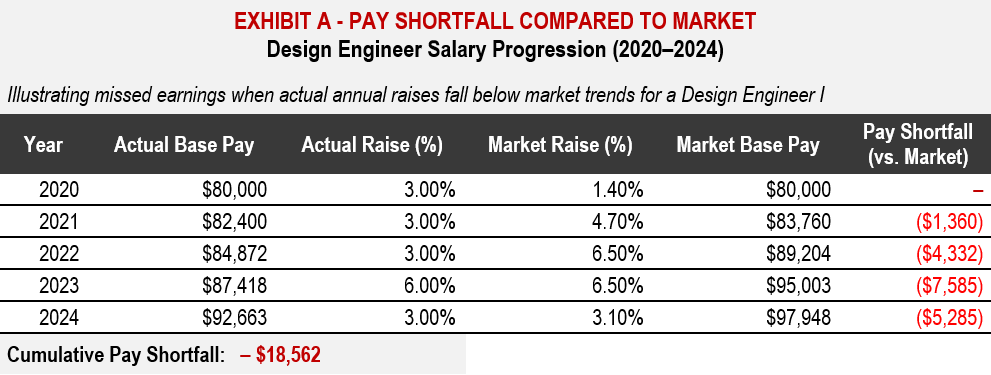
For example, Exhibit A below shows a Design Engineer’s base pay at a company that only offered 3 percent market rate adjustments for inflation from 2020 to 2025.
In this scenario, a “Design Engineer I” was hired in 2020 at the median market base pay of $80,000. The company gave the traditional 3 percent annual increase to account for inflation (market rate adjustment). In 2023, the engineer was promoted to a “Design Engineer II” with a 3 percent pay increase on top of the 3 percent annual inflation (6% total).
Then, another “Design Engineer I” is hired in 2024 at the median market rate of $97,948, while a five-year veteran “Design Engineer II” only makes $92,663. Not only is the five-year veteran paid $6,617 less in base pay compared to the Design Engineer I with no experience, but that individual also lost $18,561 over five years compared to their market value.
Three main contributing factors trigger this phenomenon within an organization:
- Market-driven salary inflation: The cost of labor has increased. The demand for workers continues to outpace the supply of qualified candidates, creating a competitive labor market. Infrastructure investments, the COVID pandemic, fewer people entering the field, and baby boomer retirements have all contributed to a skilled labor shortage. To attract new hires, companies have increased starting wages sharply from 2021-2022, often without making proportional adjustments for their more tenured and experienced employees. Reactive hiring that prioritizes filling roles fast over internal equity is a short-sighted strategy.
- Economy and persistent inflation: Cost-of-living increases, especially in urban areas and high-demand geographies. Greater mobility among workers has disrupted traditional compensation models and stressed companies’ existing pay scales. Entry-level workers and new hires can demand more pay to keep up with basic living expenses.
- Lack of deliberate compensation policy and/or infrequent salary reviews: Failure to develop a compensation policy to make appropriate market-rate adjustments for existing employees at consistent times is problematic. Many AEC firms have given only 2-3 percent incremental raises over recent years, stagnating the wages of their long-term employees. Additionally, some companies misappropriately lump merit increases with market-rate adjustments. Merit-based increases, when applicable, should be applied in addition to market-rate adjustments. Combining the two means lagging wages for their long-time, high-performing employees.
- Lack of budget agility: If companies only raise wages for new hires to remain competitive and have no budget for market-based adjustments across the board, then the pay differential shrinks for senior employees.
Warning Signs Within an Organization
The signs of wage compression within an organization may initially be subtle but become more pronounced over time. Key indicators include:
- Small pay differentials between new hires and employees with 3+ years of experience are becoming the norm, especially in high-demand markets. Even if only a few employees, news travels quickly, especially in smaller workplaces.
- Disengagement among senior employees is typical when they feel their contributions and tenure are not being fairly recognized and compensated compared to employees they mentor, supervise, or manage. There is less motivation to go beyond baseline job expectations.
- Difficulty with internal promotions is likely when existing employees are reluctant to take on more responsibilities. There is less motivation to take on leadership roles if there is little difference in pay. This is especially true when lateral moves to other firms offer better pay for similar roles.
- Resentment or low morale among long-time employees is evident. These dynamics create a vicious cycle of dissatisfaction and erode a firm’s culture and competitive advantage.
Consequences of Wage Compression
The most immediate consequence of wage compression is attrition. High turnover is common when employees realize they can earn more by changing employers. The consequences of talent retention due to wage compression include:
- Loss of institutional knowledge, which is critical for managing complex infrastructure projects, maintaining project continuity, and upholding client relationships.
- Reduced mentorship opportunities, as fewer senior staff remain to provide guidance, leading to a skills gap among junior employees and diminished technical quality.
- Tension between team members. This erosion of morale can impact team cohesion and reduce project efficiency. Perceived pay inequities undermine trust and cause cultural conflicts.
- As turnover increases, recruitment and training costs increase, and firms must constantly onboard and train new hires.
- Potential legal and reputational consequences, particularly if pay disparities are perceived as discriminatory or inequitable.
- Safety concerns arise as experienced supervisors leave, and less-seasoned workers move up too quickly or are forced to take on responsibilities. Technical errors are more likely, and work quality drops when staff wear multiple hats while vacant roles are filled.
Strategies to Address Wage Compression
Firms are often caught between market pressures and budget constraints, unsure how to address pay disparities without upsetting internal structures or exploding compensation budgets. The following strategies can help forward-thinking firms prevent wage compression.
1. Benchmarking & Equity Reviews
Data-driven decision-making is essential to ensuring fair pay. Firms should perform comprehensive compensation benchmarking at least every 2 years (ideally annually, but sometimes every 6 months for hotter sectors (i.e., Datacenter Construction) or high-demand roles (i.e., ITS Project Managers). Firms should:
- Invest in third-party surveys or consultants for salary data to compare your salaries and salary ranges to the market rate. Avoid free salary data available on the internet, as these sources are self-reported by internet users and not validated for accuracy.
- Compare team salaries to updated market benchmarks. Flag any roles where internal compression exceeds 5-10%. Adjust salaries where necessary or reclassify employees whose roles have evolved.
- Consider a “market delta clause” in your compensation policy. Suppose a new hire’s starting salary exceeds the midpoint of the pay band by a predetermined threshold (say, 5%). In that case, it should automatically trigger a compensation review for internal peers in the same role and pay level.
- For example, if a new Structural Engineer III is hired at $110K and the midpoint for that level is $105K, peers within 5 percent of that midpoint should be flagged for potential retroactive adjustment. This normalizes internal equity without waiting for complaints. It also builds trust and shows that your firm proactively values fairness.
2. Structured Career Progression & Pay Transparency
Lack of clear advancement pathways often contributes to wage compression. When employees see a tangible connection between performance, experience, and compensation, they are more likely to remain committed to the firm. HR Teams should:
- Define career progression frameworks with transparent criteria for promotions and corresponding salary increases.
- Communicate compensation philosophy openly so employees understand how compensation decisions are made and what is required to move up.
- Provide clear learning and development paths to promote from within rather than hiring externally at inflated market rates.
- Foster an open culture that allows employees to feel comfortable discussing career options and avoid feeling pigeonholed into their current role or career path. This allows existing employees to take on new roles without having to quit.
3. Budget for a “Compression Relief Fund”
By budgeting proactively, savvy business leaders reduce the likelihood of emergency raises, morale fallout, or costly turnover. This sends a positive signal to employees that leadership acknowledges the problem and is committed to solving it.
Businesses should consider setting aside 1-2 percent of payroll yearly to address wage compression. Use this fund to make strategic adjustments for high performers or vulnerable roles. Also, these funds could be used for emergency situations where a signing bonus (instead of an above-market rate offer) is necessary to hire the right talent.
4. Non-Salary Compensation Adjustments
In cases where immediate salary increases are not feasible or companies do not have the budget, firms can enhance other aspects of their Total Rewards strategy, such as offering:
- Improved benefits packages like more generous PTO, lower medical insurance premiums, attractive wellness programs, and retirement contributions.
- Flexible work arrangements can be especially attractive to a mid-career level professional who may value better work-life balance over money.
- Targeted bonuses or stipends for mentoring, upskilling, reskilling, or continuing education.
The Transparency Imperative
Compensation was once a private matter between HR and leadership, but today’s workforce demands greater transparency. Open communication about pay is now essential—not only to build trust, but also to effectively address challenges like wage compression.
If organizations fail to proactively communicate about compensation, employees will seek answers elsewhere, turning to online sources where inaccurate or incomplete information can quickly fuel unrealistic expectations, erode trust, and create avoidable challenges.
Business leaders—particularly in the traditionally conservative AEC industry—should prioritize structured and equitable salary practices to reduce the perception and reality of inconsistent or arbitrary pay disparities. Research shows that fair pay and pay transparency contribute to increased employee engagement and motivation, higher productivity, and stronger retention rates.
Final Thoughts
Does your company have a strong compensation philosophy to guide your compensation strategy? Business leaders must take a hard look at their compensation programs and ensure they reflect not only market realities but also place value on internal equity and financial sustainability.
Key takeaways include:
1. Wage compression erodes retention, morale, and profitability. It is easier to take preventative measures to avoid than to ignore and remedy once problematic.
2. Regular benchmarking should be conducted to verify that internal pay aligns with the external market rate and to stay competitive.
3. HR teams must look beyond just hiring and recruitment. Pay equity and retention must be a part of the long-term compensation strategy for a resilient workplace.
4. Proactive (not reactive) compensation reviews, clear progression within career paths, and transparent pay structures are essential elements to address wage compression.
5. Transparency is an imperative in today’s workplace.
Wage compression is more than a financial issue—it is a cultural and operational challenge that, left unchecked, can undermine a company’s future. Bridging the wage gap between entry-level and experienced professionals is not only possible—it is essential for an organization’s long-term success.