
Competing for Talent with PE-Backed Firms: Using Long-Term Incentives to Win

Private equity (PE) has become one of the most disruptive forces in the architecture, engineering, and construction (AEC) industry. Over the past decade, PE investment has accelerated mergers and acquisitions and reshaped how firms compete for leadership talent. Independent firms now face growing pressure to attract and retain emerging leaders who increasingly have opportunities with larger and PE-backed organizations.
Picture a senior project manager weighing an offer from a $60 million local firm against a PE-backed company promising a clear path to equity-like upside over the next five years.
Thoughtfully designed long-term incentive plans (LTIPs) can help address this challenge. These programs provide meaningful financial compensation for key employees without requiring ownership dilution or loss of control. They can also serve as effective succession tools by bridging the gap between current owners and next-generation leaders who may not yet be ready—or able—to purchase equity.
Talent Market Trends and LTIP Prevalence
AEC firms are operating in one of the most competitive talent markets in decades. As experienced leaders retire and demand continues to exceed supply, compensation strategies are rapidly evolving beyond traditional salary and annual bonus structures.
Privately held AEC companies are increasingly adopting long-term incentives to retain and motivate key leaders. Adoption has risen from 9 percent of private firms in 2015 to 36 percent in 2025, representing a threefold increase.
In other industries, LTIPs are already a standard component of executive compensation.
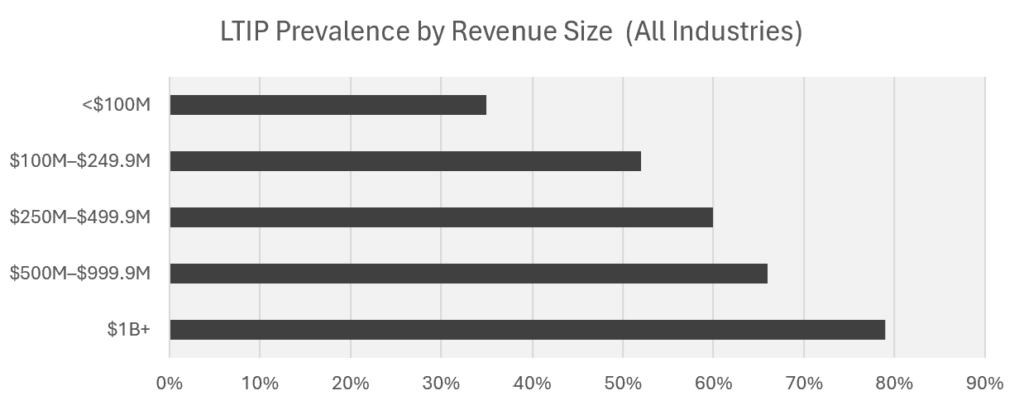
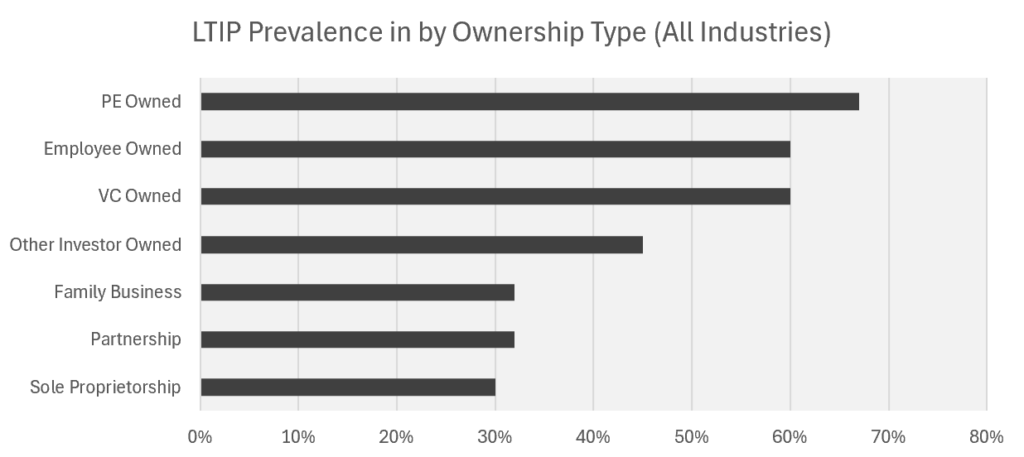
The tables below illustrate LTIP prevalence by company revenue and ownership structure based on Chief Executive Group’s 2024 compensation report for privately held U.S. companies.
Source: Chief Executive Research, October 2025
Source: Chief Executive Research, October 2025
LTIPs in the AEC Industry
Despite broader adoption across industries, LTIPs remain relatively uncommon among AEC firms with less than $100 million in annual revenue.
Most firms in this segment are founder-owned, partner-owned, or family-owned organizations where equity is viewed as something earned over decades rather than granted as a retention tool. Offering equity-like rewards to emerging leaders can raise concerns about ownership dilution.
Several LTIP structures are specifically designed for privately held firms and do not require equity dilution. Phantom stock and stock appreciation rights are two of the more common types of equity-like awards. Many plans are also performance-based, meaning payouts occur only if metrics such as revenue growth, profitability, or firm valuation targets are achieved.
LTIP awards are typically earned over a period of 3-5 years, which makes them long-term plans.
Traditional AEC Compensation Models Are No Longer Enough
Most privately held AEC firms still rely on a familiar formula: competitive base salaries, annual bonuses, and discretionary profit sharing.
At the same time, compensation gaps between large and small firms continue to widen. Professionals at firms exceeding $300 million in annual revenue often earn 15–25 percent more in direct compensation than peers in comparable roles at smaller firms (Pearl Meyer). Without a clear connection between individual performance and long-term firm performance, high performers (particularly those under 55) may see limited wealth-building opportunities compared with peers at larger or PE-backed companies.
Turnover further increases the stakes. When recruiting costs, lost productivity, institutional knowledge, and client disruption are considered, replacing a mid-level professional can cost 150–200 percent of annual salary, and significantly more for leadership roles (PSMJ).
In this environment, long-term incentives are becoming less of a corporate luxury and more of a strategic retention tool. For many AEC owners, the question is no longer whether LTIPs are appropriate, but how to structure them to align employee performance with long-term company performance.
Long-Term Incentive Plans Explained
A long-term incentive plan (LTIP) is usually a non-qualified deferred compensation arrangement, where awards are earned based on performance today but paid in the future often after three to five years or upon a service milestone.
Some LTIPs operate like an internal stock market, letting key employees share in firm growth without receiving actual ownership or voting rights, while others use long-term performance measures such as internal rate of return, gross margin, or operating income over multiple years.
Unlike qualified plans such as 401(k)s or ESOPs, LTIPs are selective, typically covering only 5 to 20 percent of employees whose decisions materially affect long-term firm performance.
Because they are non-qualified, companies have wide discretion over eligibility and design, and many plans fall under ERISA’s “top-hat” rules or outside ERISA entirely, which in practice means a focused leadership group and far less administrative burden than broad-based retirement plans.
The most powerful feature is vesting: it determines when awards are truly earned, creating retention leverage even if payouts occur later at retirement, separation, or another milestone. LTIPs do not require upfront funding; firms expense awards over the vesting period, record a liability, and stagger future payouts to avoid cash strain, with participants typically taxed at ordinary income rates when they receive the benefit.
With disciplined financial modeling, firms can align future payout obligations with projected profitability and cash flow.
Best LTIP Plan Vehicle for Private AEC Firms
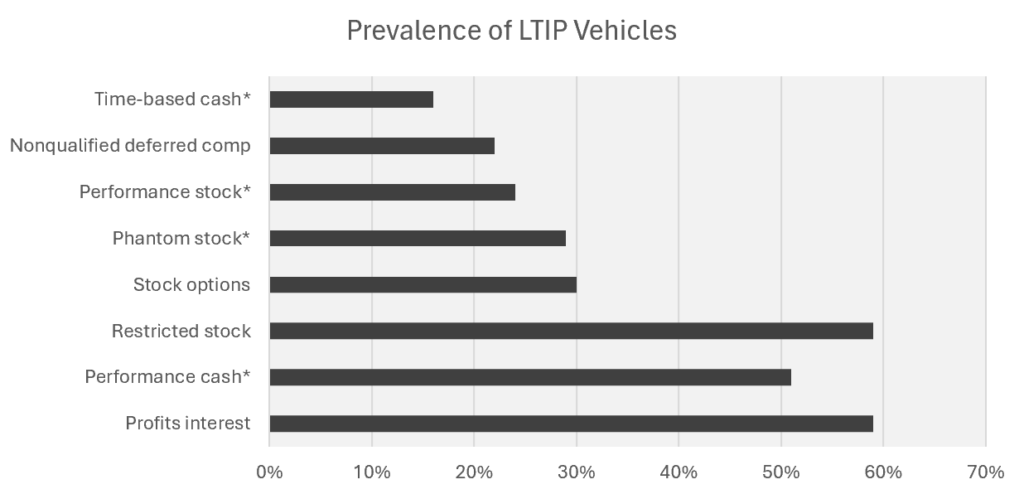
The table below outlines common long-term incentive vehicles and their prevalence among U.S. privately held companies with annual revenues between $500 million and $1 billion.
*These LTIP Vehicles do not offer real equity in the company. Performance stock can be either real equity or synthetic depending on how the plan is structured.
Source: Deloitte GES Executive Compensation Survey, July 2025
While some vehicles—such as restricted stock and stock options—grant actual ownership, many LTIP structures provide equity-like rewards without issuing shares. This distinction is important for privately held firms, where many companies do not want to use real equity for a variety of reasons.
When properly designed, long-term incentive plans can deliver performance-based compensation while preserving ownership control and avoiding unnecessary governance and tax complexity.
Situations Where LTIPs Strengthen Talent Retention
The following scenarios illustrate where an LTIP can create measurable strategic value:
-
Mid-size engineering firm losing PMs to PE-backed competitors
-
Founder-led firm preparing for leadership transition in the next 10 years
-
One hundred percent (100%) ESOP-owned engineering firm seeking to retain the next generation of leaders with an additional compensation component
-
Family-owned construction firm professionalizing operations and retaining non-family executives in key leadership roles
Designing LTIPs That Actually Compete
When structured right, LTIPs offer real competitive muscle. Key success factors include:
-
Meaningful Financial Rewards: Targeted payouts of 15–50 percent of annual base salary depending on the position and the size of the company.
-
Transparent Metrics: Use simple measures tied to value creation and performance: EBITDA, Utilization Rate, WIP, Cost Performance Index, or net fee per labor hour.
-
Separate from the Annual Bonus: Short-term incentives typically reward income statement results. Long-term incentives should focus on longer-term or cumulative goals, balance sheets, and valuation measures.
-
Financial Guardrails: Some plans include minimum profitability thresholds before payout occurs.
-
Selective Participation: Focus on top 5–20 percent of leadership/management talent tied directly to firm performance and in some cases their management and ownership succession plans.
-
Clear Communication: Explain both the business rationale and the “line of sight” between results and rewards.
Implementation: From Concept to Execution
Most private AEC firms can move from concept to launch within a single planning cycle because LTIP plans are typically built on financial metrics and processes companies already track.
Most private AEC LTIPs are structured as cash-settled or phantom equity plans, meaning firms usually do not need to modify their ownership structure, operating agreement, or cap table. As a result, implementation is primarily a design and communication exercise rather than an infrastructure overhaul.
With clear objectives and coordination between leadership and finance, a $60M revenue firm with less than 300 employees and 15 LTIP participants can move from initial design discussions to signed participation agreements in less than 90-180 days.
Final Thoughts
When structured appropriately, long-term incentive plans provide a powerful yet flexible mechanism to retain emerging leaders and key talent, align incentives with firm performance, and strengthen the management and leadership pipeline without sacrificing voting control.
Once associated primarily with large corporate firms, they are perfectly accessible to engineering and construction companies of all sizes.
For firms under $100 million in revenue, the strategic risk may not be implementing LTIPs; it may be failing to do so. Without a credible path to long-term wealth participation, many high-performing project managers leave before reaching the principal level, often joining competitors that offer clearer economic upside.
The firms that succeed in the next decade will provide a transparent and credible path for top performers to participate in the long-term value they help create.


