
The Great Campus Reset: What It Means for Engineering Firms

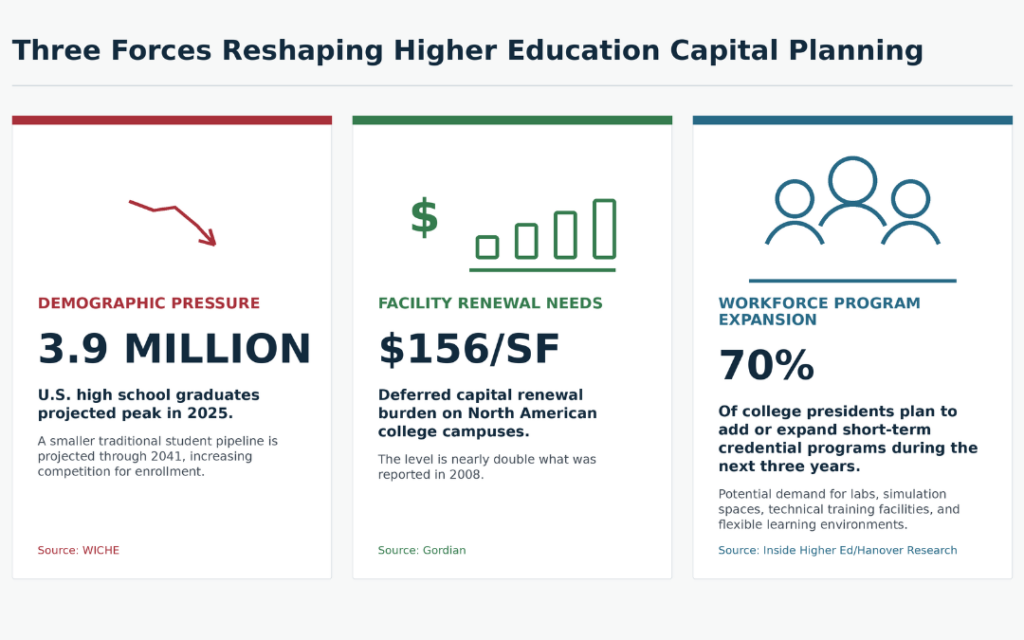
The U.S. high school graduate population is projected to peak at 3.9 million in 2025 before declining to 3.4 million by 2041, according to the Western Interstate Commission for Higher Education. For colleges and universities, that demographic shift is converging with aging facilities, tighter capital budgets, and growing competition for students. The result is a campus reset: fewer institutions are planning around expansion, and more are focused on renewal, modernization, and better use of existing assets.
For years, higher education planning was shaped by expectations of growth. More students often meant new academic buildings, residence halls, student centers, and supporting infrastructure. Today, many institutions face a different reality. The central question is no longer how much space to add, but how to make existing space more useful, efficient, and aligned with institutional strategy.
Aging Assets Drive Capital Decisions
Many colleges and universities are facing substantial facility renewal needs. Gordian’s 2026 higher education facilities benchmark data found that deferred capital renewal on North American college campuses has climbed to $156 per gross square foot, nearly double 2008 levels.
That creates a difficult balancing act. Even institutions facing enrollment uncertainty cannot indefinitely defer investments in aging building systems, utilities, and infrastructure. Mechanical, electrical, plumbing, and life-safety systems continue to age regardless of enrollment trends. Many campuses are also managing facilities built for a different generation of students, technologies, and academic programs.
As institutions prioritize limited capital resources, engineering opportunities are increasingly tied to facility-condition assessments, deferred-maintenance planning, infrastructure upgrades, and targeted renovations.
Workforce Programs Change Facility Needs
Higher education leaders are also rethinking academic offerings to better align with workforce needs. According to the Inside Higher Ed/Hanover Research 2026 Survey of College and University Presidents, 70 percent of presidents report plans to add or expand short-term credential programs over the next three years. The same survey found that 38 percent are pursuing co-op programs and 37 percent are pursuing apprenticeship pathways.
These shifts have direct implications for the built environment. Workforce-oriented programs often require specialized teaching laboratories, simulation environments, technical training space, and flexible learning facilities that differ from traditional classrooms. Some institutions may build new space, but many will adapt existing buildings to support these programs. That creates demand for renovation planning, system upgrades, and phased facility transformations.
Consolidation Creates Infrastructure Challenges
Financial pressure, demographic change, operating costs, and infrastructure needs are also pushing more college leaders to consider consolidation strategies. The Inside Higher Ed/Hanover Research survey found that 20 percent of presidents reported serious internal merger talks in the past 12 months. Looking ahead, 11 percent said their institution is likely to merge into or be acquired by another institution within five years, while 21 percent said their institution is likely to acquire another college or university.
For engineering firms, consolidation can create complex facility and infrastructure assignments. Mergers and acquisitions often require facility-condition assessments, infrastructure evaluations, asset inventories, space-utilization studies, and long-term capital planning. Institutions need to determine which facilities should be retained, renovated, consolidated, repurposed, or retired. For acquiring institutions, the work often shifts from campus expansion to integrating inherited assets into a long-term facilities strategy.
The next decade in higher education may be defined less by building outward and more by making existing campuses work harder. For engineering firms, the opportunity is to help institutions assess facility risk, modernize infrastructure, adapt space for new academic models, and maximize the value of assets already in place.


