

Engineering Firms Report Rebounding Economic Confidence, Accelerating AI Investment
ACEC Research Institute Q1 2026 Engineering Business Sentiment finds durable backlogs, improving national outlook, and a decisive strategic shift toward artificial intelligence adoption
The ACEC Research Institute’s new data shows engineering firm leaders are significantly more optimistic about the U.S. economy than they were just three months ago. Confidence in the U.S. economy rebounded 11 points to a +45 net rating even as firms manage for steady performance rather than rapid expansion, according to the Q1 2026 Engineering Business Sentiment study released today.
The quarterly survey of 628 executive-level leaders at engineering and design firms nationwide finds an industry operating from a position of strength: firm-level financial confidence stands at +82 with industry outlook at +76. The gains in economic confidence were broad-based, with improvements registered across every firm size category and geographic region.
“Engineering firms are clearly well-positioned entering 2026, with recovering confidence in the broader economy which was particularly noteworthy with smaller engineering firms,” said Joe Bates, senior research consultant with the ACEC Research Institute. “But the most significant story isn’t just about current conditions; it’s about how firms are positioning for the future, particularly around artificial intelligence.”
Moving from Experiment to Strategy in AI
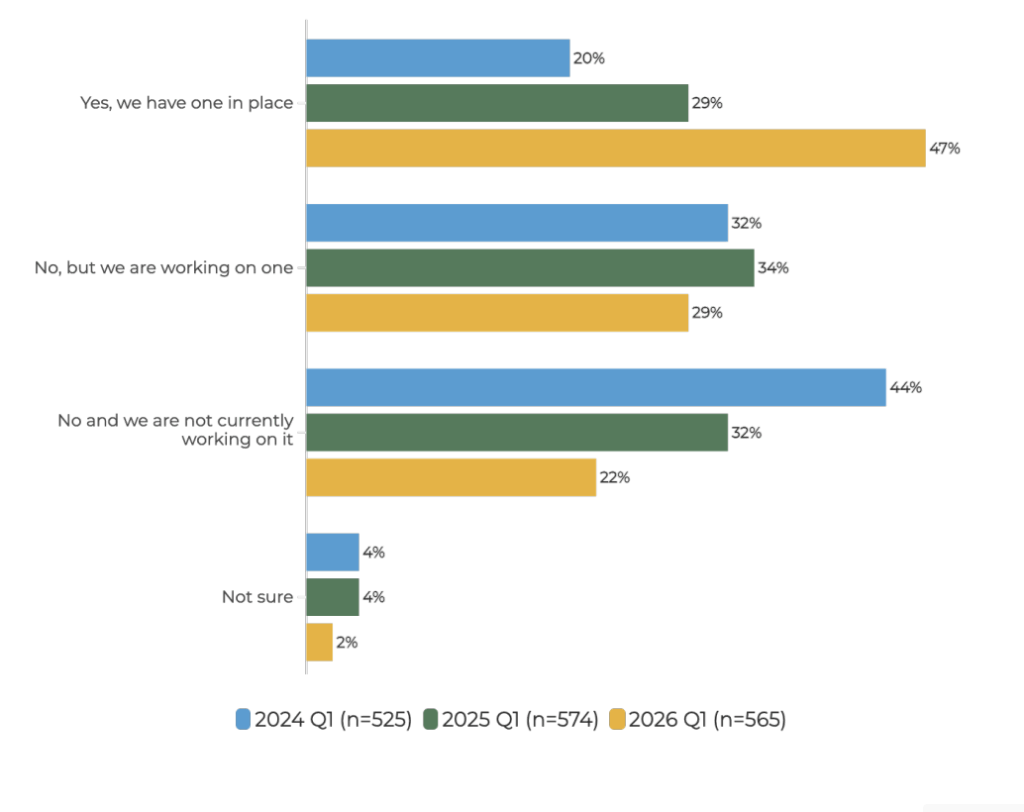
The survey documents an increase in the number of firms developing AI strategies across the engineering sector compared to prior years. Expectations for AI’s positive business impact are overwhelming among respondents, and more than half of firms report investing in dedicated AI-focused talent. Firm leaders also express confidence that most of their current workforce can adapt to emerging digital skills and processes.
Workforce Constraints Persist, With Early Signs of Easing
Labor market pressures remain a defining challenge, though the survey detects early signs of moderation. Median open positions per firm edged down to five, and salary increases are cooling, averaging 7% for new hires and 6% for existing employees, both below prior-year levels. Staff turnover is stable at an average of 8% annually.
Market Demand Bifurcated; Forward Outlook Cautious
Market performance remains uneven. Data centers (+89 net rating) and energy and utilities (+78) continue to lead all sectors in current sentiment, while government buildings, education, and transit have softened significantly from year-ago levels.
Looking ahead, firms expect continued strength in their own financial performance (+36) and gradual improvement in industry conditions (+14), while views of the U.S. economy have only just returned to positive territory at +3. Nearly two-thirds of firms project increased hiring over the next 12 months, and backlog expectations strengthened to +31. Political uncertainty (cited by 91% of respondents) and general economic uncertainty (81%) remain the dominant concerns shaping executive decision-making, though recession probability estimates declined seven points to 38%.
About the Survey
The ACEC Research Institute Engineering Business Sentiment study is conducted quarterly among executive-level leaders at ACEC member firms. The Q1 2026 survey was fielded January 13–25, 2026, by the Institute for Association and Nonprofit Research (IFANR), with 628 completed responses from a census of member firm executives. Net ratings are calculated by subtracting negative ratings from positive ratings; a positive value indicates optimistic sentiment.
About the ACEC Research Institute
The ACEC Research Institute is the independent research arm of the American Council of Engineering Companies (ACEC). Its mission is to deliver knowledge and business strategies that guide and elevate the engineering industry, advancing a more sustainable, safe, and technically advanced built environment.